
The strike stays the same; the condition can change
An impaired Proof coin is a Proof whose condition has suffered through wear, mishandling or another surface problem. The important distinction is that Proof describes how the coin was made. Spending it, rubbing it or damaging it does not turn it into a business strike.
The term needs context. A seller may use “impaired” loosely for an unattractive Proof, while a grading reference may use it more narrowly. Before deciding what a listing means, identify the source of the description and read the complete grading result.
Why definitions of impaired Proof differ
The PCGS glossary defines an impaired Proof as a circulated Proof grading below PR60. Under that definition, a numerical result such as PR55 describes a worn Proof, not a Mint State coin that narrowly missed a higher grade.
NGC’s Details glossary uses IMPAIRED for Proofs with light circulation or mishandling whose original Proof surfaces can still be detected. NGC also explains that certain surface problems prevent a numerical grade, requiring a Details assessment instead.
There is a historical reason for the broader everyday usage. In The Proof Condition, NGC describes an earlier practice of grouping scratched, hairlined or rubbed Proofs under the impaired label. Modern grading distinguishes their states of preservation more precisely. Treat a seller’s shorthand as a starting point for questions, not a universal grading category.
Read the whole label, not just the word Proof
| Example wording | What it tells you | What it does not establish |
|---|---|---|
| PR55 | Proof manufacture with a numerical condition grade below 60. | That the coin is a business strike or has no value. |
| PF63 | A numerical Proof grade; NGC uses PF for Proof. | That every surface is flawless or free of visible hairlines. |
| PROOF AU DETAILS with a qualifier | Light wear plus the separately described grading problem. | A particular numerical grade or a fixed percentage discount. |
| “Impaired Proof” in a seller’s description | The seller is reporting a condition concern. | A professional attribution, exact grade or complete diagnosis. |
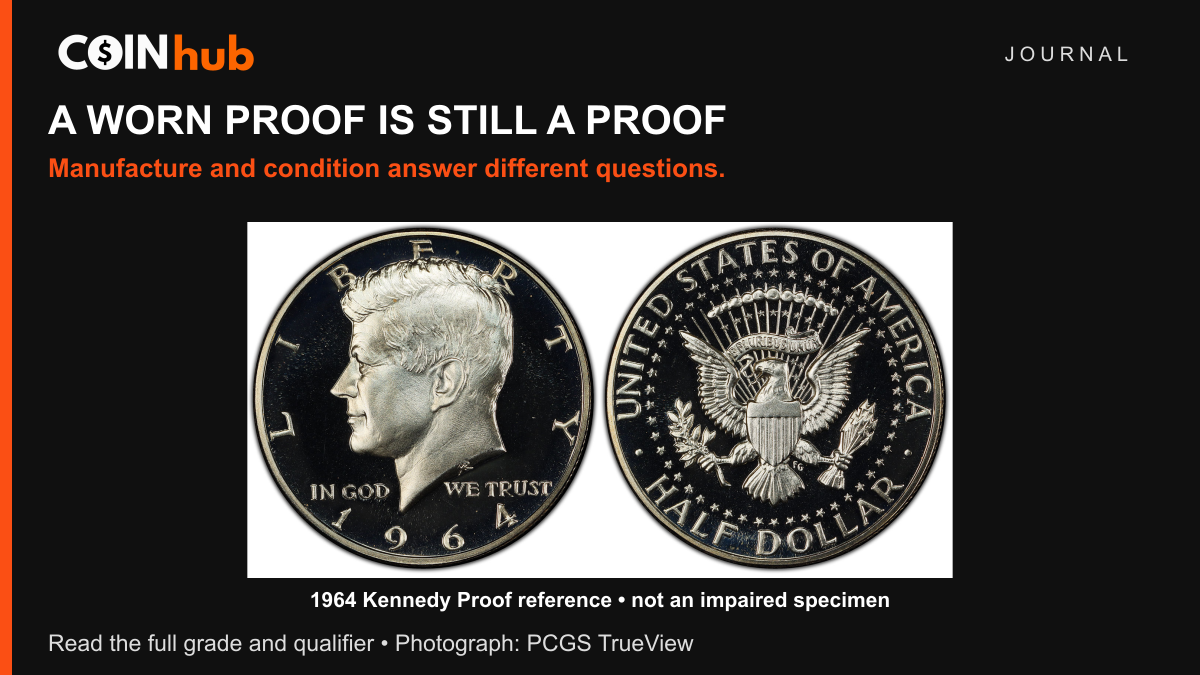
These are reading examples, not grades assigned to the photograph above. That genuine 1964 Kennedy half dollar is PCGS’s Deep Cameo reference. It illustrates a Proof’s appearance and is not presented as an impaired specimen.
NGC’s Proof-types guide also shows why a familiar mirrored appearance is not the whole definition: Proof finishes vary. For the different question of a reflective business strike, use our Prooflike versus Proof guide.
A hairline, a worn high point and a spot are different observations
NGC’s condition discussion considers friction, spotting and hairlines, including their extent and visual impact. A few marks do not let you assign a grade by formula. Nor does one hairline automatically prove that a coin falls below PR60. Cameo contrast is evaluated separately from the numerical condition grade.
Make your inspection notes literal. “Parallel fine lines visible when tilted” is more useful than immediately writing “spent for years.” “Flattening on the highest detail” records something you can compare. “Cloudy patch near the date” leaves open whether another angle or specialist examination is needed.
Photographs can hide marks behind glare or exaggerate them under harsh light. Ask for full views of both sides and a short tilt video when a surface concern affects a buying decision. Do not wipe the coin to improve the photograph. Keep it protected and follow an edge-first handling routine.
Build a useful record before comparing value
- Identify the issue. Record date, denomination, mint mark and the evidence that it is a Proof. A shiny finish by itself is insufficient.
- Copy the exact assessment. Keep the service, number, qualifier and certification number together. Separate an owner’s opinion from a professional label.
- Describe the concern. Note the side, location and visibility of wear, lines or spots. Preserve uncropped photographs alongside any close-up.
- Compare like specimens. Match the issue and relevant condition, rather than comparing an unspecified impaired coin with a top-grade auction record.
The word impaired is not a price list. Avoid both “all Proofs are valuable” and “a worn Proof is only face value.” Before paying for grading or selling, investigate the particular issue and genuinely comparable specimens. Our Details-grade guide explains why a surface qualifier cannot be converted into a fixed numerical discount.
Questions collectors ask
Does taking a Proof out of its package make it impaired?
Removal and damage are separate events. The act of changing a holder does not establish wear or a surface problem. Inspect and describe the coin’s actual condition; do not use missing packaging as a substitute for that assessment.
Can a Proof found in change still be identified?
It can, but the location of the find does not prove the attribution. Check the issue and surviving characteristics. When wear obscures the evidence, preserve that uncertainty and seek a specialist’s opinion.
Can cleaning make an impaired Proof perfect again?
Cleaning cannot replace metal lost to wear or erase a scratch without altering the surface. Do not experiment to chase a label. A professional can assess whether a residue is suitable for conservation; that is different from reversing physical damage.
Sources and photograph: PCGS and NGC references checked September 26, 2026. The unaltered PCGS TrueView photograph is used with permission and credit as a Proof reference. No numerical grade or impairment is assigned to that coin here.