
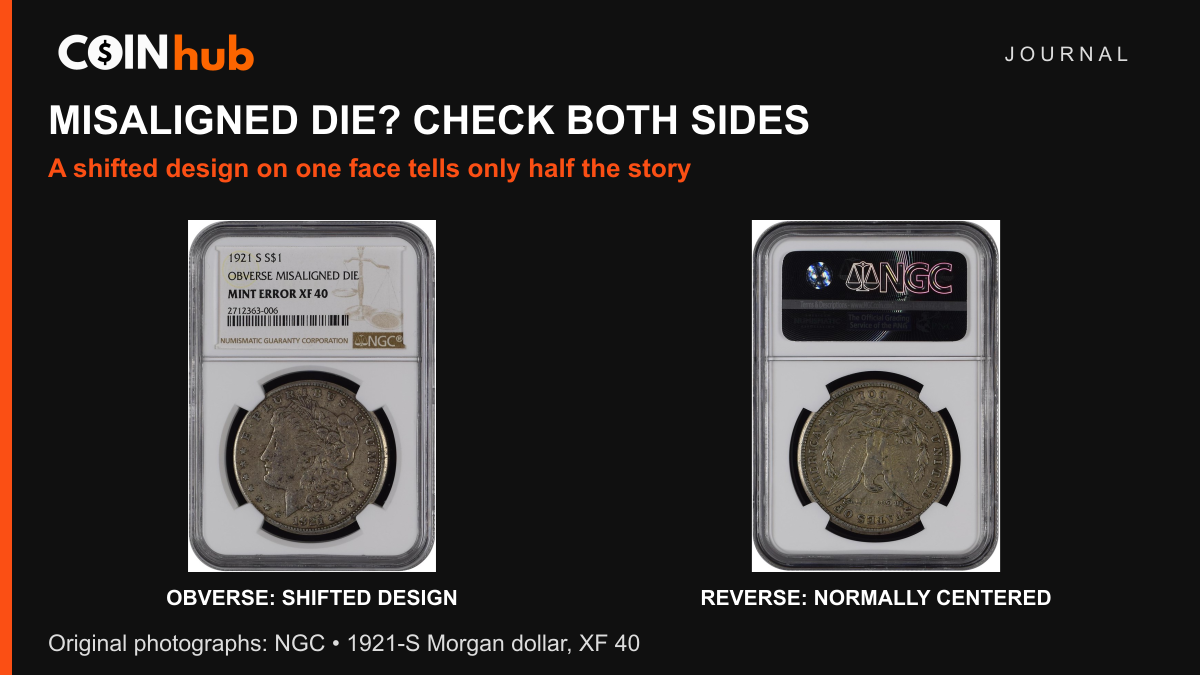
Compare the position of both designs before naming the error
The first photograph of an odd coin often shows its most dramatic side. That is also why it can be misleading. Without the reverse, the full rim and a useful view of the edge, you may be missing the evidence that separates a die-position problem from a misplaced blank or later damage.
What moved during the strike?
A die carries the design that is impressed into a coin. In the horizontal misalignment discussed here, a die is displaced sideways from its proper position. NGC describes the characteristic result as an apparently off-center design on one side with a properly aligned opposite side.
This guide concerns that sideways displacement. Tilted or nonparallel dies can produce more complicated effects, and multiple errors can occur together. A simple two-face comparison is a screening method, not a rule that classifies every unusual strike.
Study the certified 1921-S Morgan dollar
The paired photographs show an NGC-certified 1921-S Morgan dollar labeled Obverse Misaligned Die, Mint Error XF 40. Look around the obverse perimeter: the small toothlike border details, called denticles, become difficult to see along the left. NGC notes that the same problem is absent from the reverse.
The complete holder photographs preserve the source's orientation. The reverse lettering appears upside down in its holder photograph; this picture arrangement is not evidence of a rotated-die error. For centering, compare the design's distance from the perimeter all the way around each face.
Use a three-part inspection
- Compare both faces. Is only one design displaced, or do both show missing design and an unstruck area? Keep the whole coin in frame; a tight crop can hide the relevant border.
- Follow the rim around the coin. Note where it becomes wider and where it narrows. Then distinguish a shifted design from a local dent, flattened area or scrape.
- Examine the edge without altering it. Photograph unusual deformation. Do not straighten, file or squeeze the coin to make the pattern easier to interpret.
If the evidence is incomplete, describe what you see: “obverse design closer to the left edge; reverse appears centered.” That is more useful than assigning an unsupported error percentage or price.
Separate the common lookalikes
| Observation | What to investigate | Important limit |
|---|---|---|
| One face shifted; opposite face centered | Horizontal die misalignment | Confirm the full rims and rule out damage |
| Both designs displaced with missing design | Off-center strike | Check the whole planchet and any unstruck area |
| Crushed edge with scratches or displaced metal | Post-mint damage | A strange outline alone does not prove a mint error |
| Apparently doubled letters | A different diagnostic question | Do not infer a doubled die from poor centering |
NGC's off-center explanation describes a planchet extending beyond the dies during striking. CoinHub's off-center strike guide covers that separate problem in more detail. For dollar-specific context, use the dollar coin error guide.
Do not turn a small shift into a guaranteed premium
A confirmed error name does not supply a universal value. The coin's identity, condition, degree of displacement, clarity of the effect and buyer demand still matter. A dramatic certified example is not a price comparison for every slightly uneven rim found in change.
Before paying for certification, seek an informed opinion and compare genuinely similar completed sales. Save straight-on photographs of both faces, a full edge view where useful, the date and mintmark, and any existing holder label. Follow the coin photography guide without cleaning the coin first.
Diagnostic sources: NGC's mint-error education and off-center strike articles, accessed September 28, 2026. The illustrated grade and attribution apply only to that documented Morgan dollar.