
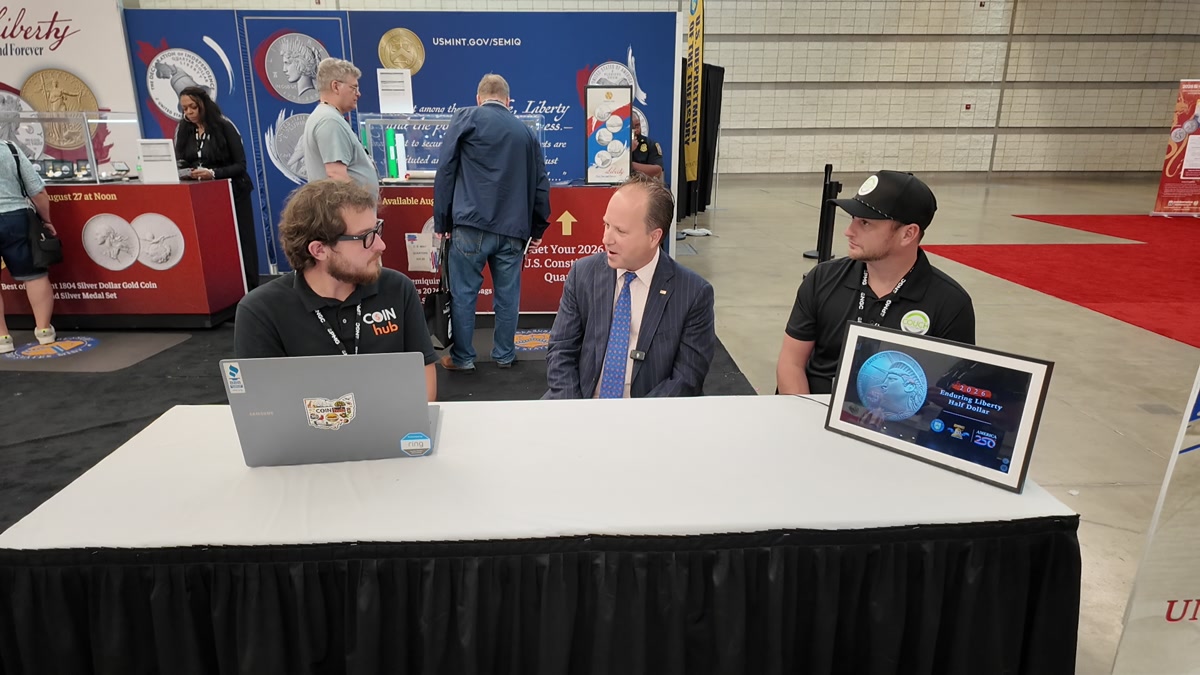
Paul Hollis says he worries about bots buying coins to resell for more money. The U.S. Mint director says a team is working on the problem. He does not say bots have been stopped or promise a new way to buy coins.
In the CoinHub interview with Blake Alma and Justin Couch of Couch Collectibles, Hollis describes a worry many coin buyers share: missing a release, then seeing the coins for sale elsewhere at a higher price. He accepts that this is a problem, but does not promise an easy fix.
Watch Hollis discuss bots and resale premiums
The captioned clip comes from the full CoinHub interview. Hollis first talks about bots used to buy lots of coins. He links that concern to coins later sold at a premium. In this case, a premium means a price above the first selling price.
“I wish that we could do a better job at getting ahead of that, and we do have a team of people that are focused on that task.”
Paul Hollis, U.S. Mint director, in the recorded CoinHub interview
Blake Alma then raises the problem of scalpers. Hollis says even the biggest ticket firms face these issues. That is his comparison in the interview. He is not saying that coin sales and ticket sales follow the same rules.
A resale listing does not show how a coin was bought
A bot is a computer program that can do a task on its own. Here, the concern is its use to buy coins. A reseller sells an item to the next buyer. A high asking price does not show that the seller used a bot.
Take a made-up example: a release has a two-per-household limit at launch. A seller later offers ten coins. That may raise a question. But the ad does not show when the coins were bought, what rules applied then or how the seller got them. Those facts would need proof of their own.
On a small screen, swipe the table to see all three columns.
| What you can see | What it tells you | What it does not prove |
|---|---|---|
| A quick sellout | The available offer closed quickly. | How many purchases used bots. |
| A high resale asking price | What a seller is asking. | A completed sale or the seller’s buying method. |
| A household limit | The purchase cap stated for that offer and time. | That every buyer will get a coin. |
This also keeps Hollis’s answer in focus. He talks about a concern and the work of a team. He does not say how many orders were blocked or name any sellers. He gives no count of bot sales in a sellout.
The Mint’s posted rules add context
The Mint’s current product FAQ says household limits aim to give more people a chance to buy. It also says limits may be added, changed or removed. Check the rule on the exact product when you order. An old image of the page may show a different cap.
The Mint has also posted a bulk purchase agreement. The PDF is marked updated July 7, 2021. Its rules bar firms in that program from getting around the Mint’s order limits. They give bots placing several orders over the limit as an example. The Mint may cancel orders or suspend a firm from the program.
These are rules for the program in that document. They do not prove that a seller broke them or show how well they work. The interview gives Hollis’s view of the task. The posted rules give a dated example of one written control.
Keep the purchase rule separate from the outcome
Before judging a release, ask three things: What limit applied? What orders were accepted? What happened when coins were resold? A product page, order record and resale ad answer different parts of that story.
Our guide to Mint limit terms explains the labels in detail. For the wider interview context, read Hollis on access to collecting. This clip has a narrower point: he sees bots and resale premiums as a concern. He says people are working on it, and does not say the problem is solved.
Reporting note: This article uses the recorded interview and its checked captions. Mint guidance was checked October 17, 2026. The filming date is not confirmed. The short clip includes Hollis and Alma; Justin Couch is in the full interview. This is not news of a new Mint rule, proof that bots were stopped or a price forecast.