
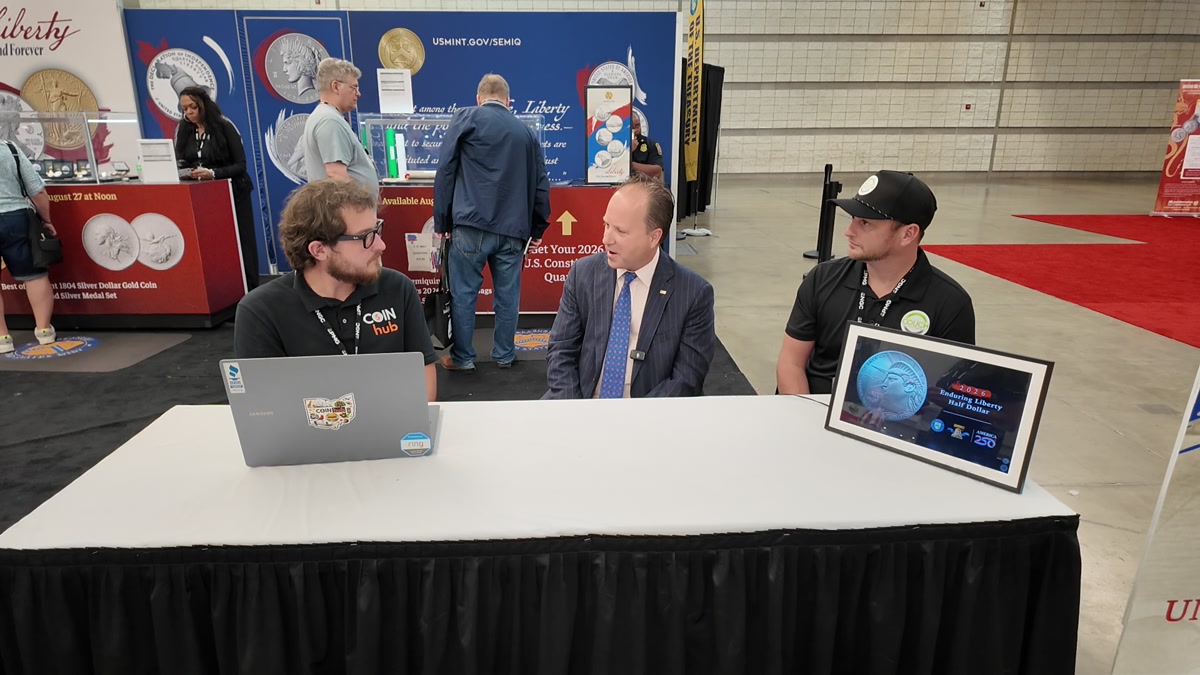
U.S. Mint Director Paul Hollis sees a coin hunt at face value as a way to bring more people into collecting. In his CoinHub interview, he explained why special privy-mark quarters went into circulation instead of being offered only through the Mint’s store. A collector could find one in change at its 25-cent face value, without first paying a collector premium.
His answer explains the purpose of the hunt. It does not promise that every collector will find a marked quarter, or that a seller must offer one for 25 cents. To understand his point, separate how the coin reaches the public from what a later buyer might pay.
Watch the captioned clip above or open it on YouTube. Hollis joined Blake Alma and Justin Couch of Couch Collectibles for the full CoinHub conversation.
Why he chose circulation over a retail launch
Hollis began with a concern he had heard from collectors: coins had become expensive. He pointed to higher gold and silver prices in explaining that concern. He made those comments in the interview. They are not a report of today’s metal prices.
He then described a way to reach people at the other end of the price range: put special coins into everyday use. “We could have put them on the USMint.gov website and sold them, but we don’t want to do that,” he said.
The next sentence gives his reason: “We said, you know what, we want every collector in America to have the opportunity to do this.” The goal he described was an opportunity to search. He was not offering a reserved coin to each person who wanted one.
How that idea reached the banking system
The Mint’s June 23 announcement said 250,000 special 2026 Declaration of Independence quarters would be mixed at random into coins for everyday use. A privy mark is a small extra design mark; these quarters carry a “July 4” mark and have no mint mark.
A July 9 Mint account of the release explains the route. The marked coins were mixed into bulk bags, then wrapped and sent through the Federal Reserve for nationwide distribution to financial institutions. That account supports Hollis’s description of a circulation hunt, rather than a separate online product.
In the clip, Hollis said the Mint had tried to spread the coins geographically so people had a chance to own them. Neither his words nor the Mint’s account says each town gets the same number of coins. They also give no bank-by-bank list. We cannot use them to work out the odds of a find in one roll.
The Mint’s account explains how marked quarters could reach ordinary change. It does not show that a local bank has any today. This article revisits the interview and the earlier release; it is not a notice of a new shipment.
Face value describes the find, not every later sale
Face value is a coin’s value as money. For a quarter, that is 25 cents. A collector premium is an amount paid above that value. Finding a marked quarter in ordinary change and buying one from a seller are two different ways to obtain the same kind of coin.
Consider two collectors. One notices a marked quarter among change already on hand and sets it aside. The other buys an identified example from a seller. The first keeps 25 cents out of spending money. The second pays the agreed sale price. Hollis’s face-value explanation concerns the first route; it does not set the second price.
That example also shows why the hunt can welcome a beginner without guaranteeing a cheap purchase. Looking through change already received does not require ordering a special Mint product. Buying a known example is a separate choice. The interview makes no promise about what that coin will be worth later.
Keep the search goal clear
For someone drawn to the idea, the first useful step is learning what the marked coin looks like. Our July 4 privy-quarter guide covers the identifying features and original release. Use that reference to check a possible find; the Declaration design alone does not make a quarter the special version.
This clip answers a different question: why use pocket change as the route into the hobby? Hollis’s answer is that it gives people a way to join the search at face value. His broader discussion of collecting access and Mint sellouts explores the separate challenge of buying limited products.
The interview’s filming date has not been confirmed. The approved clip was published September 27, 2026; the Mint sources above were checked for this October 8 report. The useful takeaway is the purpose Hollis stated, with its limits intact: an invitation to look closely at ordinary change, not a promise of a scarce coin or a profit.