
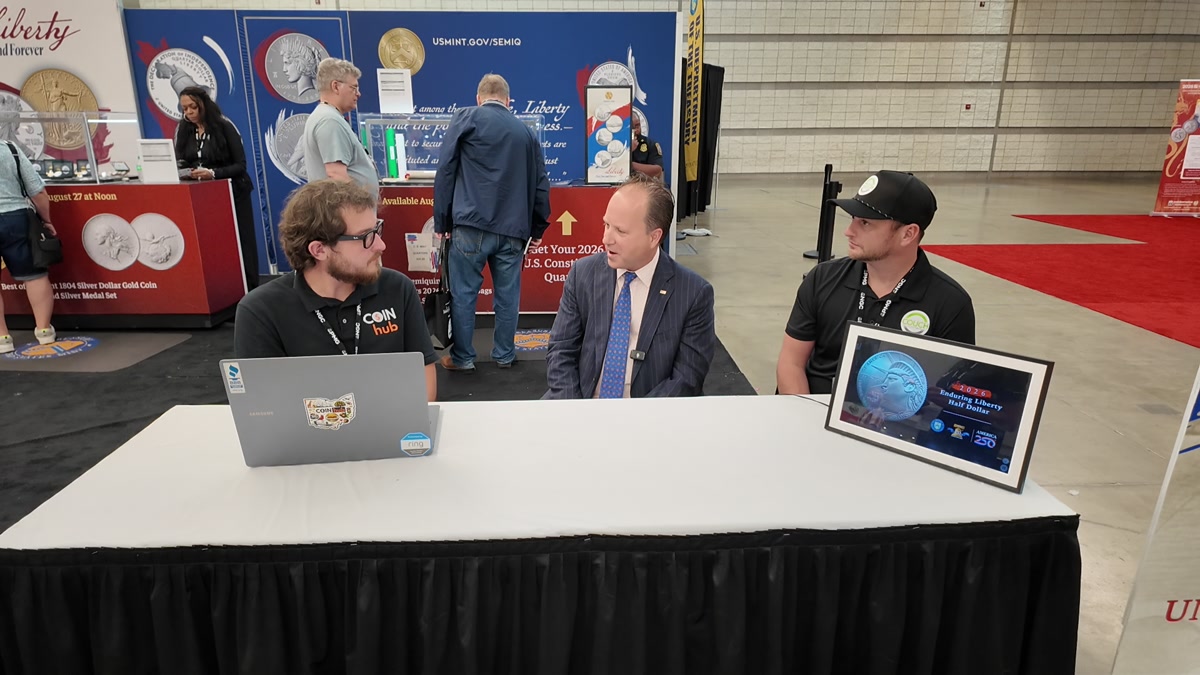
U.S. Mint Director Paul Hollis welcomes online ways to bring young people into coin collecting. In his CoinHub interview, he describes seeing young people at a coin show and taking pleasure in their interest. He is sharing what he has seen and what he enjoys. The clip does not count new collectors or announce a new Mint program.
This clip comes from Hollis’s talk with Blake Alma and Justin Couch of Couch Collectibles. The full interview covers coin designs, collector access and the Mint’s work. This passage turns to the people who may carry the hobby forward—and how they can learn once a coin catches their eye.
Hollis’s case for a new generation
In the captioned CoinHub excerpt, Hollis recalls seeing few young people at coin shows about 20 years earlier. He then points to young people around the show where he is speaking. That is what he has seen. He does not name the show or give visitor counts.
“And I get a thrill by seeing the next generation of coin collectors come into this hobby.”
— Paul Hollis, CoinHub interview
He describes those younger collectors as embracing technology. He also likes talking with people who have spent much of their lives collecting coins. His interest links two groups: people with years of knowledge and people who are just finding the subject. He welcomes different platforms that help bring them into the hobby.
The Mint’s online classroom has an earlier history
An earlier Mint report gives some context. The Coin Classroom report dated December 17, 2024 describes a new look for its teaching website. It reports simpler menus, fresh graphics and better mobile use. That date marks an earlier step in online learning. The clip does not launch that site.
The same report says the Mint first launched its education site in 1999. This work was already underway. A director can welcome online learning without each page being a new part of his term. The clip does not set a launch date, give a budget or name a new deal with a specific platform.
Current Coin Classroom pages show some ways to learn now. They list free games, hands-on activities and lessons about coins. A reader can explore those tools today. The pages do not tell us how many children went on to keep a collection, or how long their interest lasted.
Three ways to turn interest into a coin lesson
The pages offer different starting points. A game may draw someone’s eye; an activity can move the lesson away from the screen. A clear picture can help a learner name what they see. The table below describes what the Mint lists and suggests a simple goal for each.
| Resource | What the Mint lists | A useful goal |
|---|---|---|
| Games | Counting With Coins and Coin Memory Match | Practice recognizing coins and comparing amounts |
| Coin activities | Design Your Own Coin and Coin Scavenger Hunt | Ask a question and explore it away from the screen |
| Parts of a Coin | Names for the front, back, edge and other features | Describe a coin clearly before making a claim about it |
These are possible goals, rather than results from a class trial. For example, a learner could use the Mint’s diagram to point out a coin’s front and back. The terms are obverse and reverse. Next, they could explain the difference between the edge around the outside and the raised rim bordering a side.
That small task lets someone show what they have learned. It does not need a rare coin or something new to buy. Naming a part does not prove what a coin is worth. The point is to notice something that another person can see and discuss, rather than attach a price to every find.
A view count and a new collector are different things
His remarks also invite a closer look at what online numbers mean. A site lists views under its own counting rules. That number alone does not tell us a viewer’s age, whether they began a collection or whether they kept learning. The clip gives none of those figures.
Our reading is that a useful lesson gives that first spark a place to go. A video can lead to a source, a question about a design or a talk with someone who knows the coins well. Those are possible next steps. Hollis expresses pleasure in seeing more people take an interest, without putting a number on that growth.
CoinHub’s separate story about access and Mint sellouts covers the difference between entering the hobby and buying a limited release. Here, the focus is learning. A clear account and a source someone can check can help make the next talk about coins more useful.
Reporting note: Quotations follow the approved CoinHub excerpt, published on YouTube October 5, 2026. The filming date is unconfirmed. Official education pages were checked November 1, 2026; the classroom redesign report is dated 2024. The photograph shows Alma, Hollis and Couch at the interview. Find Couch Collectibles on Facebook and YouTube.