
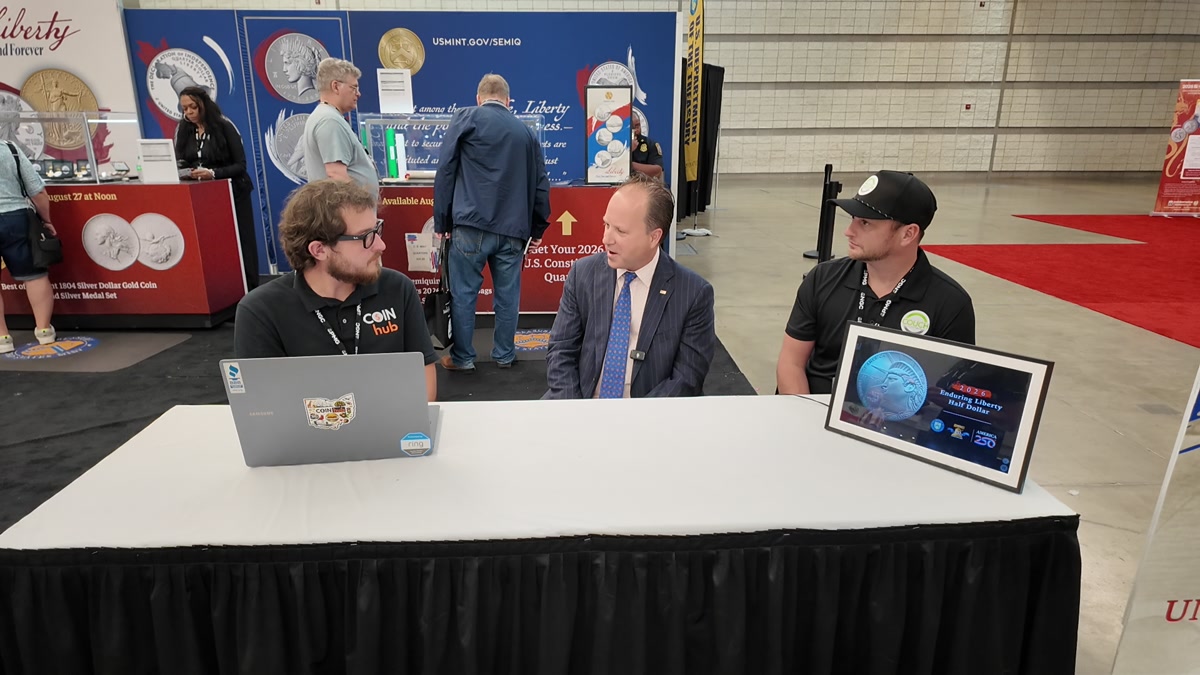
Paul Hollis remembers taking coins to school because he wanted other children to see what he saw in them. In his CoinHub interview, the U.S. Mint director recalls showing off steel pennies and giving Buffalo nickels to classmates. His reason was simple: he wanted to share American history, rather than turn those childhood exchanges into a way to make money.
The passage comes from Hollis’s talk with Blake Alma and Justin Couch of Couch Collectibles. It follows his account of the Peace dollar his grandmother gave him. That earlier memory explains how he started. This one shows what he wanted to do once he had coins to share.
Watch Hollis tell his classroom story
Watch the captioned excerpt above, or open the original CoinHub clip. Hollis is the speaker throughout this passage. The full interview with Hollis, Alma and Couch covers collector access, coin designs and other parts of the hobby.
“It was my intent to share history”
For Hollis, the appeal was show-and-tell: hold a coin, show someone else and see what they think. He recalls buying steel cents for a dime and nice Buffalo nickels for a quarter, then giving nickels out in class. Those are the prices he remembers from childhood. They do not tell us what the same coins would cost today.
“But it was not my intent to try to make money. It was my intent to share history of our nation.”
— Paul Hollis, CoinHub interview
He remembers some children taking an interest and others not caring about the coins. Not every classmate shared his love of the hobby. What mattered to him was the chance to put an old coin in someone’s hands and explain why it was worth a closer look.
He is talking about his own childhood, rather than setting a rule for everyone who collects. Some people enjoy building a set; others like a design or a link to their family. His story makes room for the simple pleasure of sharing what you know. This part of the interview does not announce a new Mint school program.
Why those two coins can start a conversation
A steel cent offers a direct link to wartime choices. The Mint’s history of coin production explains that the 1943 cent used zinc-coated steel because copper was needed for World War II. The metal itself can start a good question: why did the country change an everyday coin that year?
The Mint’s nickel history places the Buffalo design in the years 1913–1938 and credits sculptor James Earle Fraser. Its front shows a Native American portrait; its back shows an American bison. Here, the conversation can begin with the artwork and the period it represents. No rare variety or valuable error is needed to explain those basic facts.
Those facts tell us about the coin types. They do not tell us which dates Hollis gave away, how worn the coins were or which mints made them. A mint mark, when present, is a small mark that names the mint. The clip does not show that detail for his childhood gifts, or tell us who spent those coins before him.
Keep the fact and the family story together
If you share a coin now, a short note can keep both kinds of story with it. Take this made-up example: a 1943 steel cent comes with a note that the Mint used steel to save copper for the war. The giver adds why they chose that coin. One part tells a known fact about the coin type. The other saves the story of the gift.
Keep an unclear family detail separate from what the coin shows. You can read a date and look up a design. A claim that a grandparent spent that exact coin needs more proof. For a broader way to save what you know, use CoinHub’s coin collection records checklist.
Take care of the coin while you share it. The Mint’s care guidance says to hold coins by their edges over a soft surface. It also warns that cleaning or polishing can reduce their value. A coin holder lets someone look closely without touching the design.
The story can last beyond its first owner
Near the end of the clip, Hollis links his childhood story to the Mint’s work. He says the staff know that the coins made today will outlive them and tell America’s story. He is talking about the work’s lasting role. It is not a promise about how long each coin will last.
The useful lesson from his classroom memory is to pass along the explanation with the coin. A date, a design and an honest account of why it was chosen can give the next person something to explore. Hollis’s recollection shows how that exchange mattered to him well before he became Mint director.
Reporting note: This story uses the approved CoinHub interview excerpt and the Mint’s official history, nickel and coin-care pages, checked October 23, 2026. Childhood prices and experiences are attributed to Hollis. The filming date and the exact coins given to classmates are not established. The interview photograph shows Alma, Hollis and Couch; it does not depict the childhood gifts.