
Read the evidence before naming the extra digit
A short raised line beside a date can start an enjoyable attribution project. It can also start a mistaken listing. “Repunched date,” “overdate” and “doubled die” describe different aspects of how a die was made; none can be established simply because a phone photograph looks doubled.
The core distinction: A repunched date generally records another impression of the same date punched into a die. An overdate combines evidence of different dates. Some overdates were created by repunching, while others resulted from impressions of differently dated hubs. Identify the specific variety before claiming its manufacturing cause.
Three questions that keep the terms straight
| Question | What it establishes | What it does not establish |
|---|---|---|
| Does the extra detail match the same numeral? | A possible repunched-date lead | A catalog attribution from one line alone |
| Does a different underlying numeral match a known variety? | A possible overdate identification | Whether hand punches or hubs caused it |
| Do the date position and other markers match? | Evidence linking the coin to a documented die | Grade, authenticity or market value by itself |
In the older hand-punching process, the date was added separately to the working die. An imperfectly aligned repeated impression could leave traces visible on the coins it struck. When the underlying and final dates differ, the result can be an overdate. NGC's illustrated die-variety reference treats repunched dates, overdates and misplaced dates separately.
Why an overdate can also be a doubled die
Manufacturing methods changed. If a die received impressions from hubs bearing different dates, the resulting coin could show an overdate without anyone repunching a numeral by hand. PCGS names the 1942/1 Mercury dime and 1909/8 Saint-Gaudens double eagle as hub-related examples in its repunched-date terminology.
That is why “overdate versus doubled die” is not always an either-or choice. One term can describe the visible relationship between dates while the other describes the cause. Our 1942/1 Mercury dime guide addresses that particular issue; its diagnostics should not be transferred to a different coin with a suspicious date.
A mintmark adds another distinction. A doubled-looking D or S is not a repunched date. Record the feature you are actually investigating, and keep date evidence separate from mintmark evidence. A broad label such as “double stamp” hides the very detail needed to find the right reference.
Use the 1894/1894 photograph as a catalog lesson
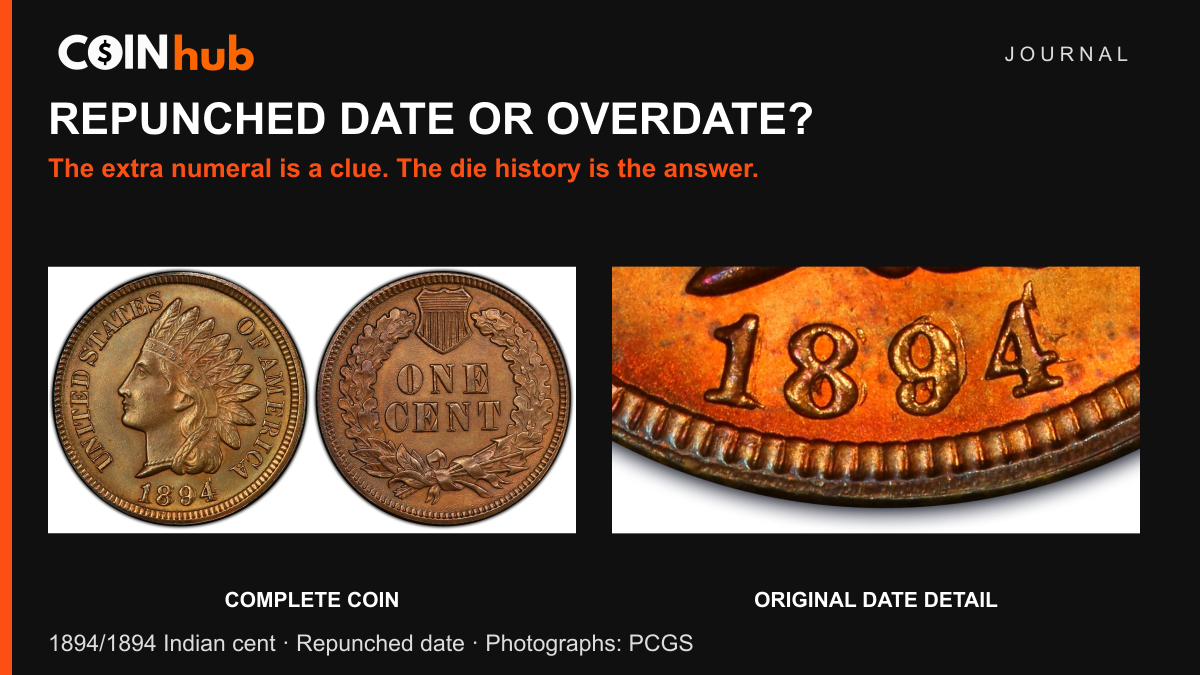
The graphic shows a genuine photographed 1894/1894 Indian Head cent and PCGS's original date-detail image. PCGS's current CoinFacts catalog identifies the relevant issue as 1894 RPD, S-1, FS-301. It is an example of same-date repunching, not an illustration of a different-year overdate.
Educational headlines and seller descriptions can use terminology loosely. When they conflict with a detailed variety listing, examine the specialist entry and its diagnostics. Preserve the exact catalog name in your notes, alongside the source and access date. Do not silently turn an uncertain resemblance into a certified designation.
Make an attribution record someone else can check
- Photograph the whole coin first. Include both sides and a sharp view of the complete date. A tight crop without context can conceal the wrong issue or an altered surface.
- Describe what is visible. Write “raised curve below the final numeral,” for example, before guessing which digit it resembles.
- Match the date's location. Compare its relationship to the rim and nearby design, as well as the extra detail itself.
- Check the rest of the documented markers. Compare only those a reliable reference identifies, allowing for stated die stages and wear.
- Record the result honestly. Use “unattributed candidate” if the evidence does not support a complete match. Keep that separate from a holder's verified attribution.
Changing the light can help distinguish relief from a reflection, but sharpening filters can also manufacture persuasive-looking edges in a photograph. Keep an unedited original. Our coin-photography guide provides a practical starting point. Do not clean the date to expose a suspected marker.
Questions collectors ask
Is every repunched date a mint error?
Collectors often group unusual coins together, but a repeating feature created in a die is normally discussed as a die variety. NGC's variety explanation distinguishes that concept from an error affecting an individual coin during production.
Does a slash in a listing prove an overdate?
No. Read both sides of the notation and verify the catalog entry. “1894/1894” describes the same date repeated; “1942/1” names a different-date relationship. A seller's notation remains a claim until checked.
Is an unusual date automatically valuable?
No. First establish authenticity and attribution, then compare the exact variety and condition with reliable completed sales. A dramatic enlargement or an unsupported rarity claim cannot supply those missing steps.
Terminology and examples checked September 17, 2026 against NGC's die-variety reference and PCGS's glossary and current variety catalog. This guide supplies an attribution workflow, not a diagnosis of an unseen coin.