
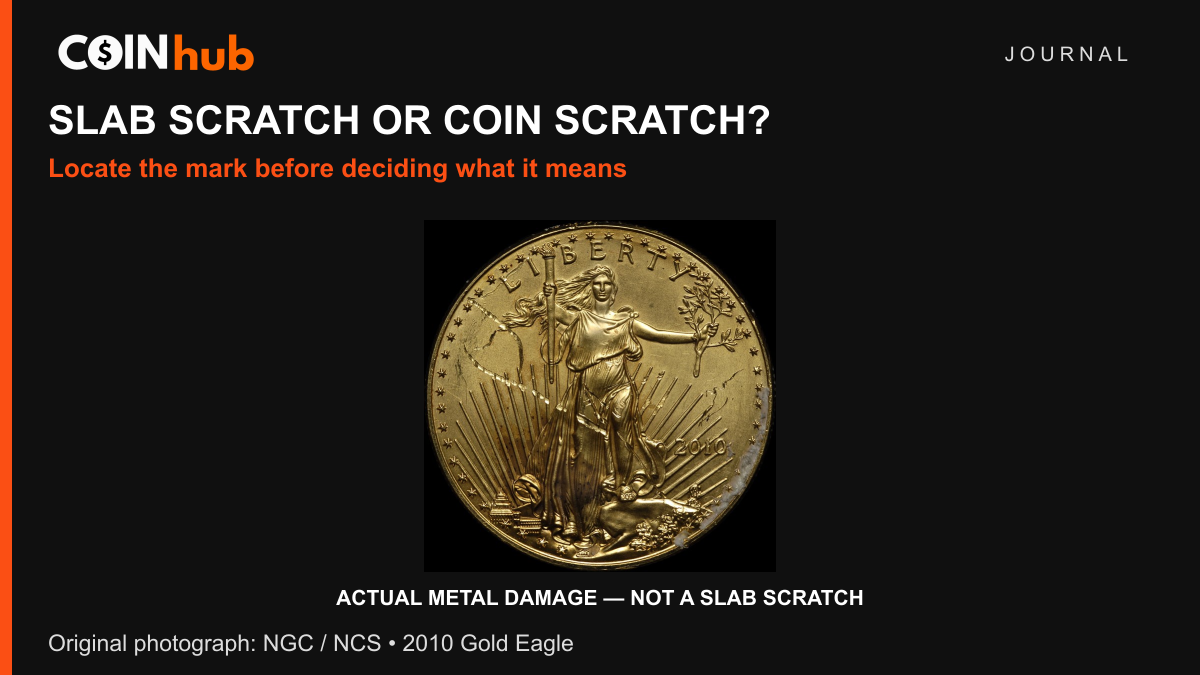
Identify the surface before judging the line
A bright line across a portrait can look alarming in a sales image. It may sit on the outer plastic, inside the holder or on the coin itself. The photograph above shows an extreme example of actual scratched metal. It is not a simulation of plastic damage, and most uncertain marks will be much less obvious.
Inspect without touching the viewing surfaces
Hold the slab by its edges over a soft surface. Start with a clean view under ordinary diffuse light, then move the light or gently change the viewing angle. Do not rub the mark, press on the holder or open it as a diagnostic experiment.
With a loupe or camera, try focusing first on the outer plastic and then on the coin. Because those surfaces are at different depths, a mark may become sharper at one focus setting than the other. This is a clue rather than a pass-or-fail test: depth of field, curved plastic, reflections and a mark on the inside surface can make the result ambiguous.
Look for continuity. If a line extends across the clear window beyond the coin's outline, that supports a holder location. If it seems to move relative to a coin feature as your viewpoint changes, the surfaces may be separated. Neither observation authenticates the coin or proves that all other marks are harmless.
Use the clues together
| What you observe | What it may suggest | What remains unresolved |
|---|---|---|
| Line continues beyond the coin onto the window | Mark on the holder | Whether additional marks are on the metal |
| Line sharpens when the plastic is in focus | Different depth from the coin | Inside versus outside plastic; optical ambiguity |
| Apparent groove with disturbed metal | Possible coin-surface damage | Severity and grading consequence need assessment |
| Line disappears under another light | Lighting changes its visibility | Disappearance alone does not establish its location |
Take an overall holder photograph and several close views with modest changes in light. Keep the originals. Avoid sharpening or contrast adjustments that make the line appear deeper than it is. CoinHub's photography guide provides a useful starting setup.
Plastic marks are not automatically a simple fix
NGC's holder policy recognizes that scratches and scuffs can occur in or on a holder. It separately explains that natural rainbow-like optical effects are not necessarily defects. Do not label every reflection a crack or every mark a service error.
For a newly returned NGC submission, contact the company or submitting dealer promptly. Its published holder-defect return policy has eligibility conditions, including an original-submitter requirement and a 14-day return window. A secondhand scratched slab is not automatically entitled to that remedy.
This inspection does not require a polishing compound, solvent or abrasive. If the viewing surface obstructs a meaningful assessment, ask the grading company about the appropriate service instead of trying an unfamiliar repair recipe.
Reholdering cannot restore scratched metal
PCGS describes Reholder as replacing the holder of an eligible PCGS-certified coin after verification; it is not a new grading submission. A new clear shell may improve the view, but it cannot undo a scratch in the coin. Our crossover, regrade and reholder guide separates those service choices.
NCS explains that scratching moves or removes metal. It does not repair that mechanical damage. Removing a contaminant can expose a previously obscured scratch; it does not mean conservation created or erased the underlying injury.
Ask a narrower question before buying
Instead of asking only whether the coin is “good,” ask the seller to identify the specific line and provide full-holder and angled close photographs. Keep any explanation in writing. If the location remains uncertain and affects your decision, seek an in-hand opinion or decline to make an assumption.
Do not apply a fixed percentage discount or automatically predict a Details grade from one image. First establish what surface is affected, then assess the particular coin and the available evidence.
Service and conservation references: PCGS, NGC and NCS, accessed September 28, 2026. The lighting checks are preliminary observations, not a substitute for an in-hand grading or authenticity assessment.