
A small part of the design can carry a large collecting decision
On a Standing Liberty quarter label, FH means Full Head. It identifies sufficient detail in a specific part of Liberty's design. It does not replace the numerical grade, guarantee an equally sharp shield, or tell you which of two coins has the more appealing surfaces.
Start with the type: PCGS describes separate Full Head criteria for Type 1 and Type 2 Standing Liberty quarters. For Type 2, look for the required leaves, lower helmet outline and ear opening. For Type 1, the separation of the hair cords and cap is central. Then evaluate the rest of the coin independently.
Find the correct design before inspecting the head
Standing Liberty quarters include a design transition during 1917. A checklist intended for the later head design can mislead someone examining the earlier type. If the type is uncertain, use our 1917 Type 1 versus Type 2 guide first. The Full Head question comes after that identification.
| Reference | Head detail to inspect | Collector's caution |
|---|---|---|
| PCGS Type 1, 1916–1917 | Hair cords clearly separated from the cap | Do not substitute the later helmet checklist |
| PCGS Type 2, 1917–1930 | Three complete distinct leaves; complete lower helmet outline; clear ear opening | One strong feature does not replace the others |
| NGC published FH explanation | Three fully visible leaves; complete hairline across the brow; evident ear indentation | Use the service's own guidance when interpreting its label |
The terminology differs slightly between the services' descriptions. Read the PCGS explanation and NGC illustrated criteria directly when checking a particular holder. A dealer's short description is not a substitute for those standards.
What the reference photographs can—and cannot—show
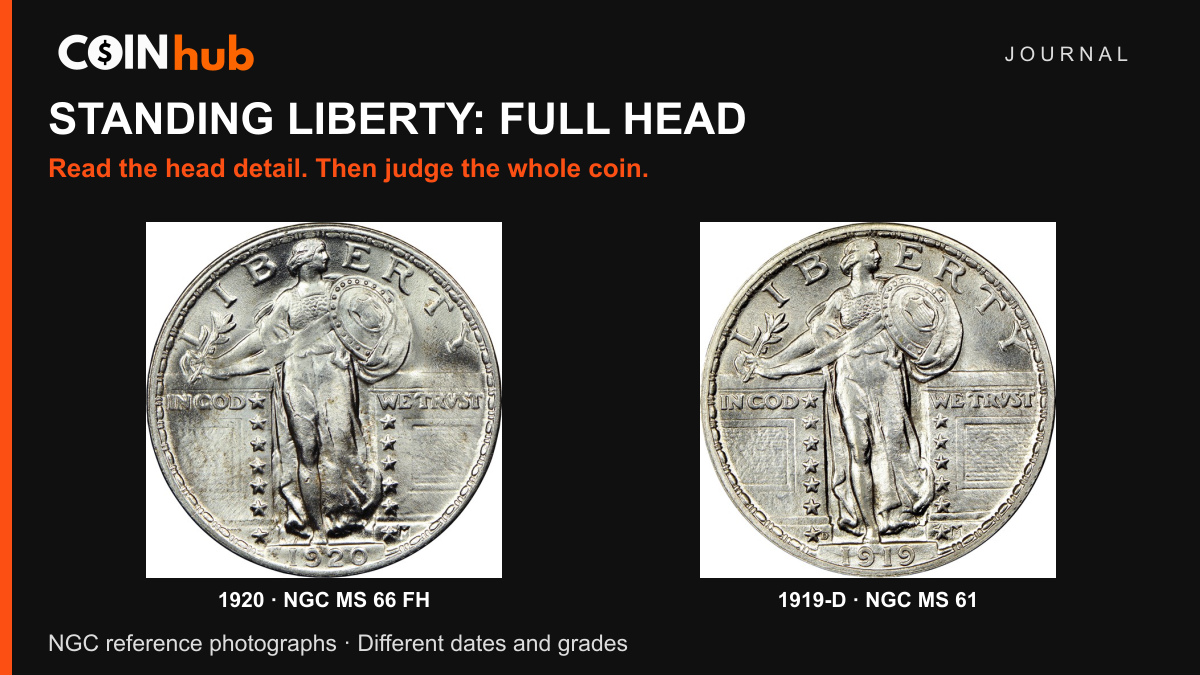
Our graphic uses NGC's real reference photographs: a 1920 quarter graded MS 66 FH and a 1919-D quarter graded MS 61 without FH. These are different dates and different grades. They illustrate labeled examples; they are not an experiment isolating the value or appearance of the FH designation at an identical grade.
For your own comparison, request a clear obverse photograph large enough to examine the head without digital sharpening. Keep a whole-coin view beside it. A bright reflection can conceal a weak area, while poor lighting can hide genuine detail. If the photograph cannot resolve the required features, record that limit rather than confidently assigning or rejecting FH.
Full Head and the numerical grade answer different questions
Head detail concerns a localized part of the strike and its surviving definition. The numerical grade considers the broader coin, including wear or preservation as applicable. Our weak strike versus wear guide explains why missing detail does not always have a single cause.
Do not assume FH applies only to Mint State pieces. PCGS's published guidance allows it generally from AU50 upward, with a stated XF40 threshold for the 1918/7-S variety. That exception does not extend to every circulated Standing Liberty quarter. Check the current service policy for the exact issue if a submission decision depends on eligibility.
Equally, an FH label does not say that every other feature is fully struck. Inspect the shield, its rivets, Liberty's body and the reverse independently. Surface marks, distracting discoloration and evidence of improper cleaning still matter. Keep the head designation in one box of your notes and the whole-coin assessment in another.
Compare the premium with a fair set of examples
A useful market comparison starts with the same date, mintmark, grading service, numerical grade and designation. Then review the actual photographs and sale terms. Comparing an attractive high-grade FH coin with a lower-grade non-FH coin does not reveal the FH premium by itself.
Make a short worksheet for each candidate: holder details, certification check, head visibility, other strike detail, surfaces, completed-sale reference and total acquisition cost. Mark any missing information. This turns “I like the FH label” into a decision you can explain and revisit. Our PCGS and NGC label guide helps separate the fields on the holder.
Questions collectors ask
Can a non-FH coin still be desirable?
Yes. A collector may prefer its surfaces, appearance, date or fit within a set. The designation is a specific collecting attribute, not a universal ranking of every quarter.
Does a clear ear alone establish Full Head?
No. The published criteria include other features. Evaluate the complete standard for the correct type and service rather than checking only the easiest detail to see.
Does FH guarantee a particular price increase?
No. Any premium depends on the exact issue, grade, quality and relevant sales evidence. For broader series context, use our Standing Liberty quarter overview; this guide focuses on interpreting FH.
Standards and specimen identities checked September 17, 2026 against PCGS and NGC educational references. This is a guide to understanding the designation, not an independent grade or guarantee that a coin will receive FH.