
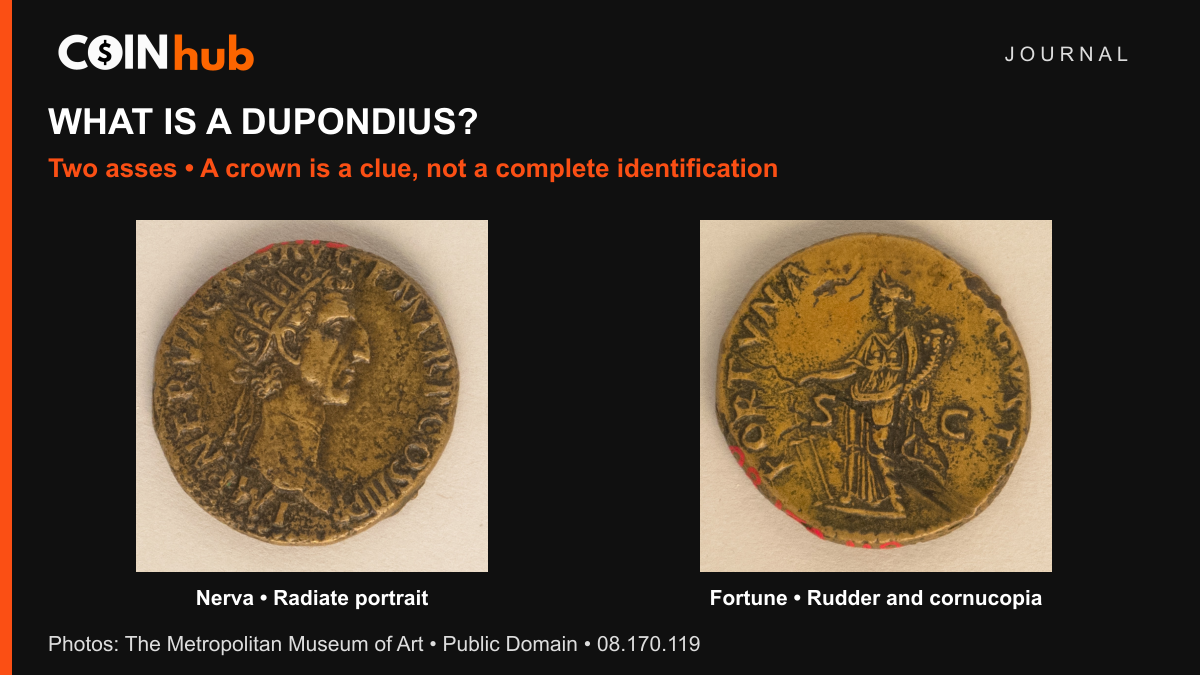
A dupondius was a Roman coin worth two asses, the plural of as. The as was a basic unit of Roman money. In the early imperial system, two dupondii equaled one sestertius, and eight equaled one denarius. Many imperial dupondii show an emperor wearing a spiked crown, but that clue does not identify every example.
The coin pictured here makes a useful starting point. It is a documented dupondius of Nerva from 97 CE. You can see the crown, compare both sides and follow the museum's record. You do not have to guess a coin's name from its color alone.
What two asses meant in Roman money
Macquarie University's introductory coin guide gives a table for the end of the Republic and start of the Principate, the age of emperors. It places the dupondius at two asses, the sestertius at four and the denarius at sixteen.
A simple exchange example: at those rates, four dupondii represent eight asses. That is two sestertii or half a denarius. This is a comparison of stated coin values, not a claim about what a Roman meal cost.
Keep the period attached to the numbers. Rome's system changed over time. Macquarie notes that the denarius had earlier been valued at ten asses before its rate changed to sixteen. A table for one period should not be carried into every other Roman century.
Our sestertius guide covers that larger unit separately. Knowing how the names fit together helps you read a catalog, but an ancient face value is not a modern sale price.
Why the crown helps, and where it can mislead
A radiate portrait shows rays around the head. A laureate portrait wears a laurel wreath. The University of Warwick's glossary explains that, under Nero, the radiate crown became a way to signal a double denomination.
That is why the crown is such a useful clue on many dupondii. Yet it was not present on every issue. Forum Ancient Coins' reference notes that Galba and Vitellius issued dupondii with bare or laureate portraits. A rule that says “no spikes means no dupondius” would miss those coins.
The opposite shortcut fails too. Other denominations used radiate portraits. The later antoninianus is a familiar example. Before choosing a name, check the ruler, period, metal and design on the back. A crown is one part of that match.
Read this Nerva coin from front to back
The Metropolitan Museum of Art's record identifies the pictured coin as a bronze dupondius of Nerva, made at Rome in 97 CE. It measures 2.6 centimeters across and weighs 11.6 grams. Its collection number is 08.170.119.
Start at the front, or obverse. The museum describes a radiate head, and NERVA appears within the recorded inscription. On the back, or reverse, it identifies Fortune holding a rudder and a cornucopia. The latter is a horn-shaped symbol of abundance. The reverse inscription includes FORTVNA AVGVST and S C.
In your own notes, separate a letter you can read from one supplied by the catalog. You might see only part of a name on a worn coin. Copy that fragment first, then record the proposed match beside it. This leaves a clear trail if you later revise the identification.
Do not turn color into a metal test
Dupondii are often discussed as brass coins, using the ancient term orichalcum. Museum and dealer catalogs can also group copper-alloy coins under bronze or the abbreviation AE. Warwick distinguishes AE, used for copper or bronze, from Or, used for orichalcum or brass.
The Met calls this particular piece bronze. Its brief record does not provide a measured alloy percentage. Keep that label as given. Do not turn a photograph, or a broad catalog term, into an exact copper-and-zinc formula.
Nor should you scrape a surface to chase a brighter color. Begin with clear photographs and the coin's existing condition. A catalog match should account for both designs, readable letters and measurements together. If those clues conflict, leave the denomination open and seek an informed examination.
A useful first description might read: “Possible dupondius; radiate portrait; these letters visible; weight and diameter recorded.” Add the reference that led to the suggestion. That is more useful than a confident name with no supporting evidence, and it gives the next person a fair chance to check your work.
Sources and photograph credit
Sources are linked beside the relevant facts: Macquarie University, the University of Warwick, Forum Ancient Coins and the Metropolitan Museum of Art. Photographs: The Metropolitan Museum of Art, Rogers Fund, 1908, object 08.170.119; Public Domain through Met Open Access. Blank background cropped and images resized; full coin edges and collection markings retained. Enlarged, not actual size.