
In English coinage, a groat is a silver coin worth four old pence, usually written 4d. The name spans several periods and designs. Identify the ruler and type before applying a weight, silver standard or collector value to a particular coin.
A worn coin with a crowned portrait and a cross can look very different from a small round fourpence showing Britannia. Both can appear in searches for groats. That does not mean they share the same size or were made in the same way.
This guide focuses on English groats and later British fourpences. Do not carry its face-value rule over to every Scottish or continental coin with a similar name. Match the country and period first.
What four old pence meant
Before Britain's decimal system, a shilling contained 12 pence and a pound contained 20 shillings. An English groat therefore represented one-third of a shilling. Three groats made a shilling; 60 made a pound. A half groat represented two pence.
The letter d means old pence in a catalog description. It is not the same unit as today's decimal penny, written p. Those old face amounts explain the coin's place in its currency. They do not tell you what a collector will pay for it now.
BullionByPost's denomination overview describes the fourpenny meaning and the related half groat. Treat retail asking prices separately from this basic identification: a dealer's price for one coin is not a value for every groat.
Start by separating the main types
Early English groats belong to the hammered-coin tradition. The coin was struck between dies, the tools carrying its design. Surviving examples can have uneven outlines, worn lettering or an off-center design. These clues help describe a coin, but none proves its identity by itself.
The London Museum records an Edward III silver groat dated 1354–1355. Its catalog gives a 26 mm diameter. That is a specific museum object, not a universal groat measurement. Our hammered-coin guide explains the manufacturing method in more detail.
Later, machine-made or milled fourpences can be much smaller. The Royal Mint's 1836 William IV Britannia groat listing specifies 16 mm, 1.89 grams and .925 sterling silver. Its reverse—the back of the coin—shows seated Britannia and the words FOUR PENCE.
Maundy fourpences are another type. Do not identify a coin as a circulation groat simply because its value is four pence. The design, date and catalog entry matter. Our Maundy money guide explains the small ceremonial coins and their role in the Royal Maundy gift.
Read the photographed coin as one example
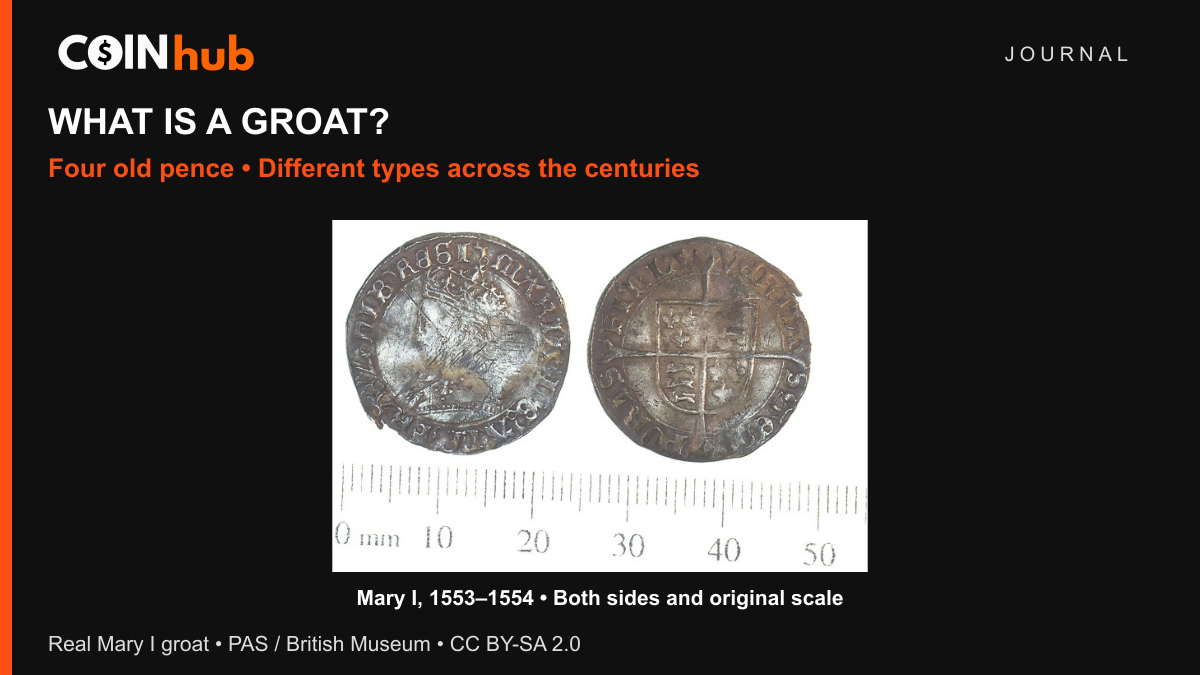
The main photograph shows a worn Mary I groat, cataloged by the Portable Antiquities Scheme as 1553–1554. A crowned portrait appears on one side; a shield and cross appear on the other. The original photograph includes a millimeter scale.
The record gives this coin's diameter as 23.8 mm and its weight as 1.9 grams. Notice that its recorded weight is close to the later William IV specification, while its diameter is much greater. Weight alone would therefore be a poor way to choose between these two types.
This is an illustration of a documented specimen. It is not a claim that all Mary groats weigh exactly that amount, or that a similar-looking coin has the same grade or value.
Make a useful identification record
Photograph both sides in clear light. Write down the letters you can actually read, leaving gaps where wear hides them. The portrait side is the obverse; the opposite side is the reverse. Record the design on each rather than guessing a ruler from the portrait alone.
Next, note the diameter and weight without scraping, polishing or bending the coin. Compare the combination of letters, design and measurements with an appropriate catalog. A groat is a denomination—a face-value category—not an authentication result.
Once the type is established, compare coins with the same ruler, issue and condition. Keep uncertainty in your notes instead of assigning the highest price found online. A qualified specialist can help with unreadable legends, unusual types or questions about authenticity. Preserve the coin as found while you investigate.
Sources checked October 8, 2026: London Museum, Royal Mint, Portable Antiquities Scheme and the denomination reference linked above. The arithmetic examples explain old face values; they are not appraisals. Photograph and adaptation credits appear beneath the main image.