
Ask what happened after the coins were struck
The difference between coin mintage and survival is the difference between original production and the coins believed to remain. A low-mintage claim can be accurate while still leaving the most useful collecting questions unanswered. Were examples saved immediately? Did they circulate heavily? Is the seller describing all survivors, or only a difficult grade?
Quick answer: Mintage alone does not prove present rarity or value. Check what the production figure measures, the issue's preservation history, the basis of any survival estimate, the condition being discussed and current availability. Keep demand separate from the physical number of coins.
1. Identify exactly what the mintage figure counts
Start with the date, mint, denomination and method of manufacture. A number for one finish or one mint cannot automatically describe every version with the same date. Record the source and its edition or access date alongside the number.
Early records need particular care. In David Lange's discussion of mintage records, annual production and the dates actually carried by early coins do not always line up, because dies could remain in use beyond their dated year. The practical lesson is to read the specialist explanation attached to a figure.
For a current Mint product, first distinguish actual production from an announced ceiling. Our Mint limit terminology guide handles mintage, product and household limits. A maximum and a completed production total answer different questions.
2. Look for evidence of saving, circulation or destruction
Research what happened to the issue after production. Evidence of early saving, prolonged storage, heavy circulation or melting can explain why the original total is a poor guide to what a collector encounters now. Do not assume that every issue of the same age had the same experience.
PCGS uses the 1950-D Jefferson nickel to illustrate how publicity about a low mintage encouraged preservation. That is a useful historical counterexample to “few struck means few left.” The article's old prices are not current valuations; our separate 1950-D nickel guide covers the issue itself.
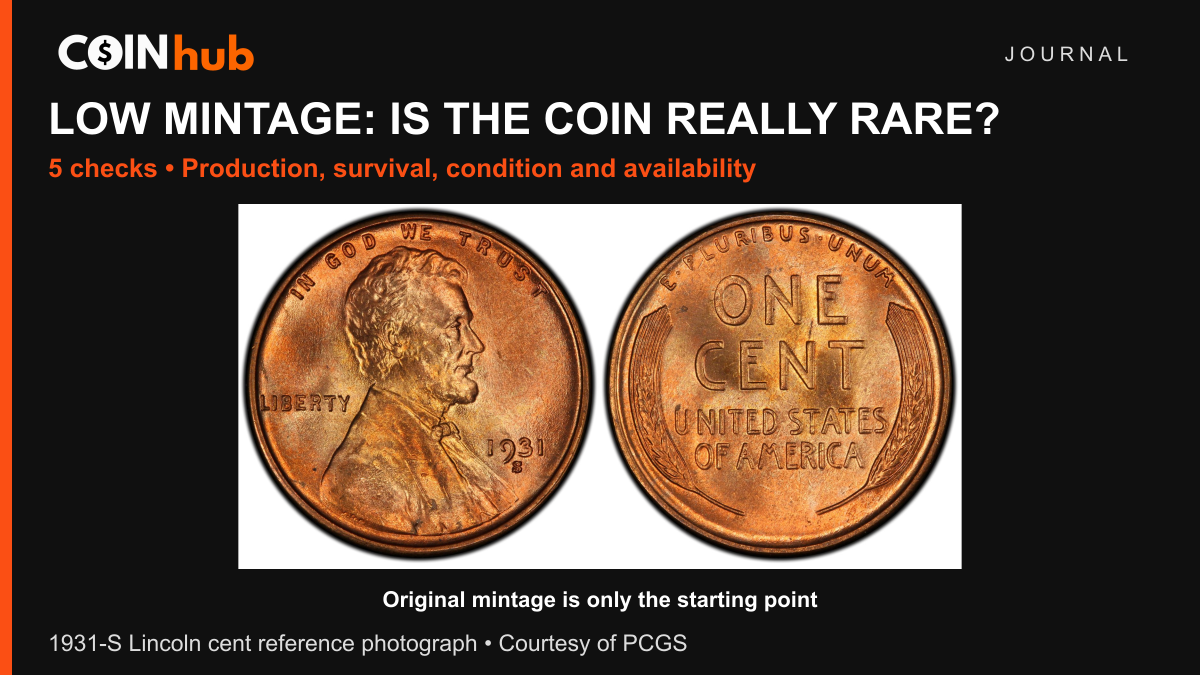
The 1931-S cent pictured above is another reason to examine an issue's story, not merely its production line. Use our 1931-S cent guide for its specific context. The photograph is not evidence of a measured survival percentage.
3. Find out how a survival estimate was made
A survival estimate is an informed estimate, not a completed inventory of every collection. PCGS describes its CoinFacts rarity framework as based on expert survival estimates, with separate scopes for all grades and selected higher-grade ranges. Such assessments can change as information develops.
Write down who supplied the estimate, when it was checked and what it includes. If a listing gives a precise survivor count with no source, leave that claim unresolved. Avoid turning “approximately” into an exact quantity when copying it into your notes.
A fictional arithmetic example: Issue A has a mintage of 20,000 and an estimated 10,000 survivors. Issue B has a mintage of 200,000 and an estimated 2,000 survivors. In this invented example, B had ten times the original production but fewer survivors. The corresponding estimated survival percentages are 50% and 1%. These numbers describe no real issue or pictured coin; they show why the two measurements cannot be interchanged.
4. Define the condition you actually want
“Hard to find” needs a condition attached. Your collecting goal might be an identifiable circulated example, an attractive Mint State coin or a particular certified designation. Research the supply relevant to that goal instead of borrowing a scarcity claim from a much narrower category.
Write one sentence before searching: “I am comparing this date and mint in this condition, with these required attributes.” If that sentence changes, reassess the evidence. A price or rarity comparison built for one grade may no longer answer your question.
Grading-service counts can help, but they are not a census of all survivors. See our population-report guide for certification counts and their limitations. Keep that source label in your notes rather than renaming a certified count “coins left.”
5. Separate surviving supply, availability and demand
Coins can survive in collections without being offered today. A search with few listings therefore measures what you found in those venues at that time; it does not establish the total remaining population. Save the search date and compare more than one appropriate sales venue before making an availability claim.
Demand is another question. Jeff Garrett's NGC discussion explains why mintage numbers do not tell the full story of collector desirability. Popularity can influence price without changing how many physical coins exist. A low supply does not, by itself, promise a strong resale market.
Record asking prices separately from completed sales. When comparing auction results, use consistent treatment of the hammer price and buyer's premium. The goal is a supported comparison, not a prediction of investment returns.
A worksheet for the next rarity claim
| Check | What to save | Leave unresolved if... |
|---|---|---|
| Production | Exact issue and the source of the figure. | The number could be a limit or a different finish. |
| History | Evidence of saving, use, storage or destruction. | The claim rests only on the coin's age. |
| Survival | Estimate, author, scope and date checked. | No method or reference is identified. |
| Condition | The grade or attributes being compared. | A narrow condition claim is applied to every example. |
| Market access | Dated listings and appropriate completed sales. | One seller's inventory is treated as the entire supply. |
After these checks, a useful conclusion may still be modest: “Low original production is documented; present survival is uncertain.” That is a better collection note than a confident rarity claim the evidence cannot support.
Can a low-mintage coin be easy to buy?
Yes. Substantial preservation and available inventory can make examples accessible. The answer may change with the grade and other attributes you require.
Is there one mintage number below which every coin is rare?
No universal cutoff can replace issue-specific research. Compare the original production with the later survival evidence and the collecting category being discussed.
Sources checked September 18, 2026. Historical articles support collecting principles, not current prices or dated survivor totals. The worked arithmetic is explicitly fictional.