
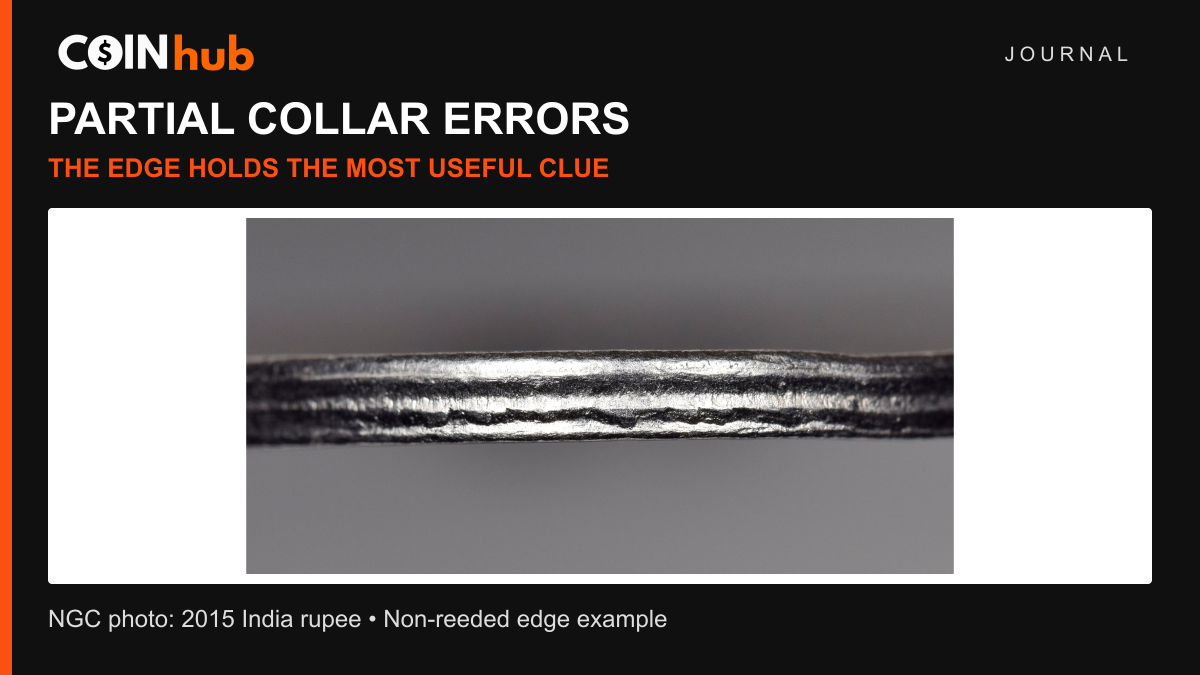
Inspect the edge before naming the error
The rim is the raised border on a coin’s face. The edge is its outside surface between the two faces. A photograph taken straight down at the portrait may show an unusual border while hiding the evidence needed to explain it. Begin with edge views, then examine both faces.
What the collar normally does
The collar surrounds the planchet during striking and limits outward metal flow. Where the collar carries grooves, it also forms the edge’s reeding. A partial collar involves incomplete confinement; a broadstrike involves a strike outside the normal collar restraint. NGC’s collar discussion explains this distinction.
Think of the diagnosis as two linked questions: which portion contacted the collar, and where did the unconfined metal go? A seller’s nickname is less useful than photographs that let you examine those areas yourself.
Three appearances to distinguish
| Form | Useful observation | Keep in mind |
|---|---|---|
| Straight partial collar, reeded edge | A relatively level transition between a collar-formed band and an expanded band | Often called a railroad rim; inspect beyond one small crop. |
| Tilted partial collar | The height of the step changes around the edge | One viewing angle may show much more of the effect than another. |
| Partial collar, plain edge | A stepped or flange-like profile without normal reeding | Sometimes described as a wagon-wheel appearance. |
NGC illustrates these forms, including the 2015 India rupee used in our hero image. That coin has a non-reeded edge and also a separate obverse cud. The photograph demonstrates a plain-edge partial collar; it is not a reeded railroad-rim specimen.
For larger views of the documented coin and other examples, open the linked NGC article. A wide header image is an introduction, not a substitute for examining an actual coin from multiple angles.
A photo checklist for a suspected partial collar
- Record the complete coin first. Take full obverse and reverse photographs so the date, denomination and design remain connected to the edge evidence.
- Photograph several edge positions. Work around the circumference, keeping the camera near edge level. Save the sequence in order.
- Look for the transition. Describe any step, changes in diameter and the boundary of reeding. Avoid interpreting a bright reflection as a physical ledge.
- Include an ordinary comparison. Use the same denomination and type. Different coin designs may have different normal edges.
- Preserve the surface. Do not file, squeeze, clean or pry at the edge to make a feature more visible. Leave a certified coin in its holder.
Error-Ref’s technical reference describes how the constrained and unconstrained portions differ. It also explains why the position of the collar-formed band can depend on press configuration. Do not reject a candidate solely because the band is nearer the “wrong” face in a photograph.
Compare nearby explanations without merging them
A broadstrike and a partial collar can both involve outward spreading, but their collar engagement differs. An off-center strike concerns the relationship between the planchet and the dies. Those names are not interchangeable descriptions for every coin with an uneven border.
Damage is another possibility to evaluate. Photograph gouges, flattening, seams or displaced metal separately instead of treating every irregularity as support for a mint error. A single suspicious feature can justify a closer look without proving how it formed.
For normal edge context, see why coins have ridges. Establish the expected edge for the issue before deciding which part departs from it.
What to send an error specialist
Send the date and denomination, both full faces, the ordered edge photographs and a short description of the observed step. If the coin is certified, include the exact label wording and certification number. If it is raw, say so. Do not present an unverified attribution as a grading-service opinion.
Ask the specialist to assess whether the photographs support partial collar, another minting mechanism, damage or an inconclusive result. If the edge cannot be seen through a holder or the images are blurred, record that limitation before discussing value.
How much is a railroad-rim coin worth?
The nickname alone cannot set a price. Identification, the coin itself, visibility of the error, condition and comparable completed sales all matter. This guide does not assign a universal dollar range to an unverified edge.
Does an extra ring on the face prove a partial collar?
No. The face view needs supporting edge evidence. Save the full coin and edge photographs together, and keep the cause uncertain until the observations support a specific explanation.
References and photograph provenance checked September 14, 2026. No rarity ranking, universal price or attribution of a reader’s coin is asserted.