
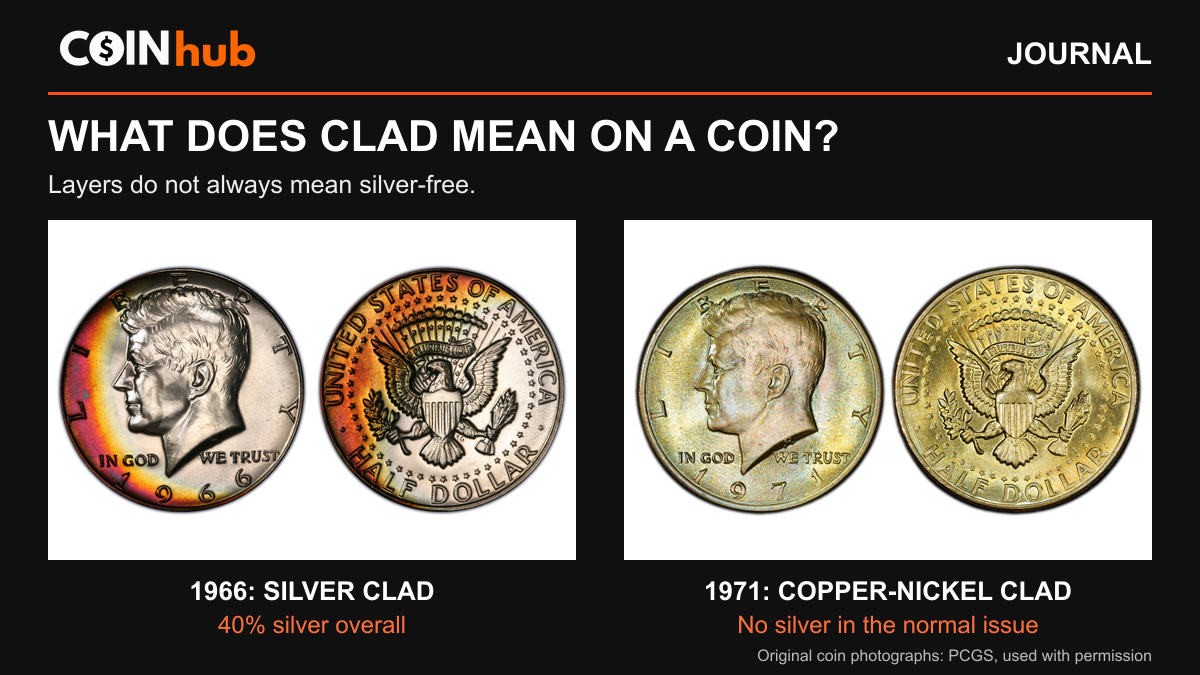
A clad coin has metal layers bonded together. A core sits between outer layers. The word describes how the coin is built, not whether it contains silver. A regular modern U.S. quarter is copper-nickel clad with no silver. A 1966 Kennedy half dollar is silver clad and contains 40% silver overall.
You may see clad on a coin label, in a price guide, or in a seller's listing. It sounds like a grade, but it is not. It tells you about the metal structure inside the coin.
Knowing that distinction helps you read listings without mixing up three different things: the metal, the finish, and the value. Start with the layers, then check the exact coin.
What does clad mean on a coin?
Think of a sandwich made from metal. The center is the core. The outside sheets become the two faces of the coin. These layers are joined before the blank is struck with a design.
The U.S. Mint's glossary defines clad coinage by its core and outer layers of different metals. A layer can itself be an alloy, which is a blend of metals. Those two terms describe different things.
For example, a regular copper-nickel clad quarter has a pure copper core. Its outer layers blend copper and nickel. The silvery faces do not make it a silver coin.
Clad does not always mean no silver
This is the trap to avoid: treating clad as another word for silver-free. The term needs a second piece of information. What metals make up those layers?
PCGS identifies the 1965-1970 Kennedy half dollar type as silver clad. These half dollars contain 40% silver overall. Their silver-bearing outer layers surround a core that also contains some silver.
The two real coins in our main photo show the difference. The 1966 half dollar is silver clad. The 1971 half dollar is copper-nickel clad, with no silver in its normal composition. PCGS records 1971 as the first year of that copper-nickel Kennedy type.
Both coins have the same basic portrait. Both can look silvery from the front. The date and exact issue tell you more than the color alone.
Clad, alloy and plated: three terms to keep apart
| Term | What it describes | Example |
|---|---|---|
| Clad | A core with bonded outer layers | A regular modern quarter: copper core, copper-nickel faces |
| Silver clad | A layered coin that contains silver | A 1965-1970 Kennedy half dollar: 40% silver overall |
| Alloy | Metals blended together, not necessarily in layers | A regular modern nickel: 75% copper and 25% nickel |
| Plated | A thin coating placed over another metal | A copper-plated zinc Lincoln cent |
The Mint makes a useful distinction here. It does not call the copper-plated zinc cent technically clad because the copper is a thin coating. In everyday listings, sellers may use the words loosely. Ask what the coin is made of rather than relying on one label.
That also explains why a normal nickel is not clad. Copper and nickel are mixed through the coin, rather than arranged as a copper core between separate face layers. The denomination's name does not mean it is made of pure nickel.
For a closer look at thin copper coatings, see our guide to plating blisters on zinc pennies. A blister is a different question from whether a coin was made from clad stock.
Read the whole-coin metal figures correctly
A common source of confusion is a percentage that describes only one part of a coin. The face-layer blend and the metal mix of the whole coin are not the same measurement.
The Mint's coin specifications table lists regular clad dimes, quarters and half dollars as 91.67% copper and 8.33% nickel overall. Their outer layers are 75% copper and 25% nickel. The pure copper core accounts for the difference.
Gold-colored U.S. dollar coins are another reminder to check the metal, not just the color. Their outer layers use manganese brass over a copper core. That golden color is not proof of gold content. Do not read gold-colored as gold coin.
Check a coin without damaging it
Start with the date and exact issue
Write down the denomination, date and mint mark. Then check a reliable reference for that issue. A series can include both regular clad coins and special silver versions.
For quarter dates, our 1964 versus 1965 quarter guide covers the silver change in detail. For dimes, use the dime silver-date guide. Those dates help with ordinary issues, but a date alone cannot rule out every special strike or error.
Use the edge as a clue, not a verdict
A regular copper-nickel clad coin often shows a copper-colored stripe along its edge. You are seeing the exposed core between the outer layers. Wear, dirt, toning and coatings can make that edge harder to read.
A stripe is useful evidence, but it is not a complete metal test. A pale edge does not prove that a coin is silver. Keep the date and issue in the picture.
Keep unusual coins intact
Do not file the edge, scratch a face, cut the coin, or apply acid to expose its metal. Those tests can damage the surface and destroy collector value.
If a coin seems wrong for its date, take clear photos and record its weight. Our coin weighing guide explains how to make a useful comparison. Weight supports a check; it does not prove an error or authenticity by itself.
Does being clad make a coin worth less?
Clad is not a value grade. A common worn coin may have little collector premium, while a scarce variety or exceptional example can be desirable. You still need the exact issue, condition and evidence behind any unusual claim.
Likewise, proof describes how a coin was made, not one fixed metal mix. A proof coin can be clad or silver. Our proof set versus mint set checklist helps you read the packaging and identify the correct product.
Before you buy: ask for the date, mint mark, exact issue and stated metal content. If a listing says only clad, you do not yet know whether it is copper-nickel clad or silver clad. If it says gold plated, that does not mean solid gold.
You do not need to memorize every metal blend to begin collecting. Learn what each term tells you, then use it to ask a better question. That is a much safer starting point than judging a coin by its color.
Photo credit: Original coin photographs by PCGS, used with CoinHub's permission. The 1966 and 1971 Kennedy half dollars are separate examples, not cutaway images or metal-test results.
References: U.S. Mint glossary and coin specifications; PCGS CoinFacts for silver-clad Kennedy half dollars and the 1971 copper-nickel issue. Metal descriptions refer to normal issue composition, not a determination about an unexamined coin.