
Establish the Basic Issue
Authentic standard Franklin halves use 90% silver. Record the date and any reverse mintmark, keeping Philadelphia's normal absence of a letter separate from Denver D or San Francisco S. The series ended in 1963 rather than following the Kennedy alloy transitions.
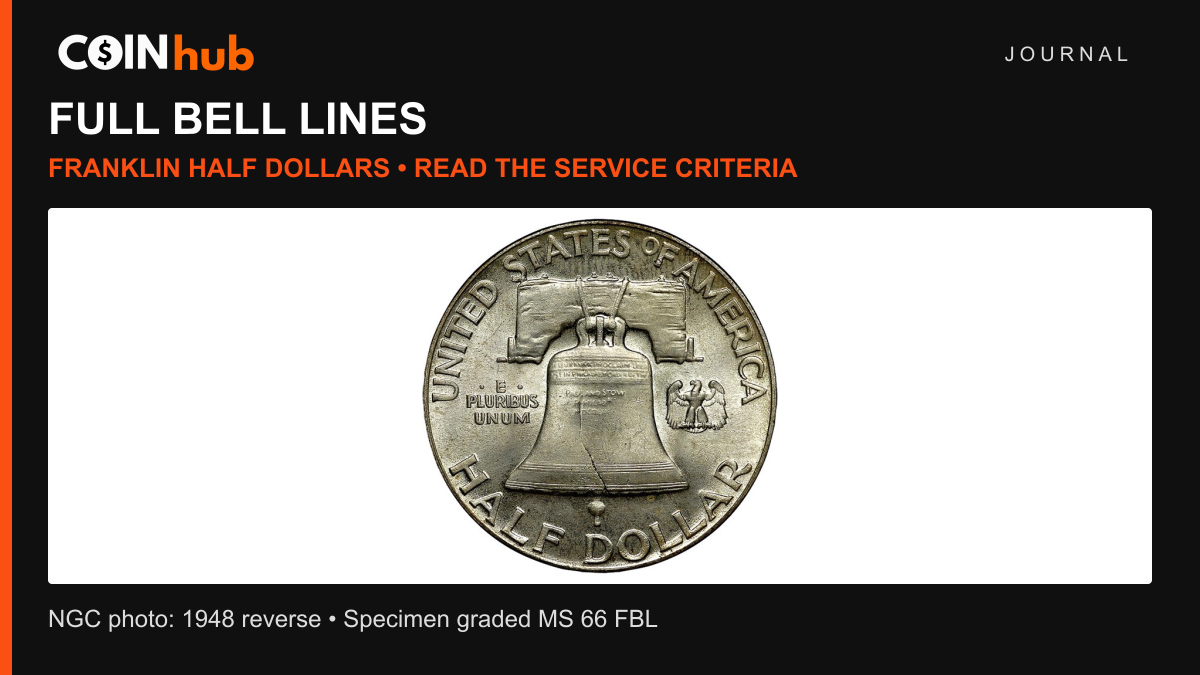
The reverse's small eagle beside the Liberty Bell is part of the normal design. The bell's familiar crack is also intentional, not a minting defect. Proofs were made from 1950 through 1963 and need a proof-specific identification rather than a brightness test.
Understand Full Bell Lines
The horizontal lines near the bottom of the bell are a useful place to inspect strike quality. Weakness can originate during manufacture. A missing segment does not automatically prove wear, while a contact mark through the lines can complicate a specialist designation.
Full Bell Lines, often abbreviated FBL, is a grading-service designation with defined requirements. NGC and PCGS standards should be checked separately. Do not assign the label from one visible line or assume the designation establishes the overall numeric grade.
Account for the Open Fields
Inspect Franklin's cheek, hair and the large surrounding fields under changing light. Bag marks, fine cleaning lines and impaired luster may be more revealing than a sharp bell. Leave toning intact; a newly polished surface is not an improvement for comparison with original coins.
For circulated examples, consider current silver content alongside the exact date and visible problems. For certified FBL coins or proofs, compare matching holders, finishes and preservation. A record price for an exceptional specimen is not the expected result for an ordinary silver half.
Confirm what you have
- Bell LinesPhotograph the lower bell in focus and note missing segments or crossing marks. Record observations without claiming an FBL determination.
- Open FieldsTilt the coin under a steady light to reveal hairlines and contact marks. A single frontal image can hide these features.
- Proof EvidenceRetain the set holder or earlier documentation. A reflective surface on a circulation coin does not prove proof manufacture.
Before you put a price on it
- Calling the Liberty Bell's designed crack an error.
- Confusing strong bell lines with a guaranteed high grade.
- Borrowing proof auction results to value circulation strikes.
Collector questions
Are standard Franklin halves silver?
Yes, the authentic standard issues are 90% silver. Collector premium and selling costs remain separate from a theoretical metal-content calculation.
Does a 1948 Franklin half have a proof version?
Regular Franklin proof production began in 1950. A claim that an ordinary 1948 piece is a proof requires exceptional supporting evidence.
Why can two sharp halves compare differently?
Their dates, mintmarks, surface preservation and certified strike designations may differ. Sharp-looking detail is only one part of the comparison.
Sources & further research
- PCGS: Franklin Half-Dollar Series and Proof Dates
- NGC: Full Bell Lines Requirements
- PCGS: Franklin Silver Composition and Small Eagle
- PCGS: Grading and Strike Designation Standards

Reviewed 2026-10-12. Coin identification, grade and value are separate questions. No guide or checkmark is professional authentication or an appraisal.
