
Recognize the Wartime Branch
The normal alloy is 75% copper and 25% nickel. During part of 1942 and through 1945, the Mint instead used 56% copper, 35% silver and 9% manganese. A large P, D or S above Monticello identifies the standard wartime silver issues.
A 1942 date alone is insufficient because both regular-alloy and silver-alloy nickels exist that year. Do not sort them by dark color: storage can discolor either alloy. Photograph the dome area before deciding whether a silver calculation belongs in the valuation.
Follow the Mintmark and Design Changes
On early regular-alloy coins and again from 1946 through 1964, branch mintmarks appear to the right of Monticello. Circulation issues dated 1965 through 1967 omit mintmarks. From 1968, the mark moved to the front; Philadelphia's P returned in 1980.
The 2004 and 2005 Westward Journey designs and the updated portrait introduced in 2006 are normal design changes. A bison reverse on a 2005 Jefferson coin is not a 1913-1938 Buffalo nickel. Let the portrait, date and reverse jointly establish the family.
Assess Preservation Before a Premium
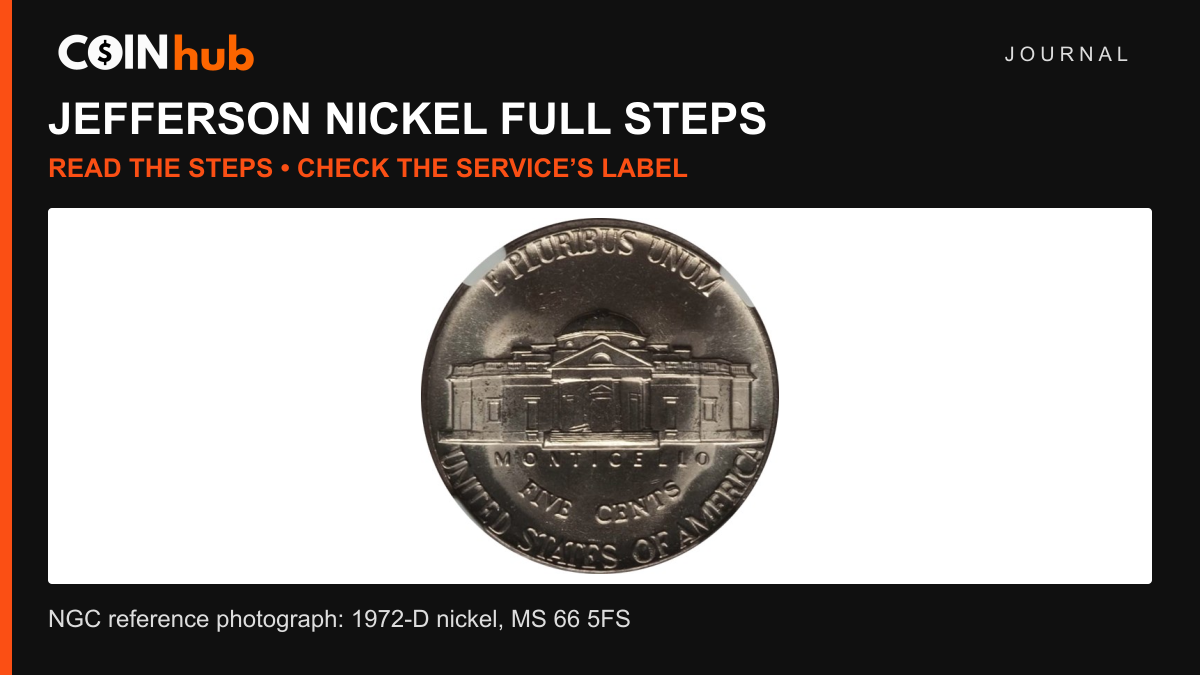
For coins with Monticello, inspect the steps, portrait and open fields. Full Steps is a specialist strike designation with service-specific requirements, not a synonym for any readable staircase. Wear or a crossing contact mark can matter even when much of the building is sharp.
Keep ordinary circulation examples, proofs and special collector finishes in separate comparison groups. Wartime coins can have collector interest beyond silver, but a metal calculation alone is not an offer. Record current source dates and compare like-for-like completed sales before deciding whether grading is worthwhile.
Confirm what you have
- 1942 CheckLook above the dome for the large mintmark. Record its location as well as its letter before assigning a composition.
- StepsPhotograph the staircase without glare, noting interruptions and wear. Do not award Full Steps or a numeric grade from a casual image.
- Issue GroupRecord the reverse design and any original set packaging. A proof should be compared with proofs of the same issue.
Before you put a price on it
- Calling every 1942 nickel silver.
- Treating 1965-1967 missing mintmarks as unexpected.
- Labeling any visible steps as a certified strike designation.
Collector questions
Why does a wartime nickel have a large P?
The large reverse letter identifies the changed wartime alloy. It was also the first use of P on a U.S. coin.
Is a 2005 bison nickel rare by design?
No. That reverse was an authorized design. A valuable variety requires additional evidence, not simply the presence of the bison.
Does Full Steps replace the grade?
No. It describes particular strike detail under the grading service's standards. Overall condition and the exact date-and-mint issue remain separate factors.
Sources & further research
- U.S. Mint: Jefferson and Westward Journey Nickel History
- PCGS: Wartime Nickel Alloy
- PCGS: Jefferson Mintmark Positions
- PCGS: Grading Standards and Strike Designations

Reviewed 2026-10-12. Coin identification, grade and value are separate questions. No guide or checkmark is professional authentication or an appraisal.
