
When the protective slide becomes a point of contact
Album slide marks are lines left on a coin by contact with an album's moving plastic slide. The PCGS glossary describes them as usually parallel. The phrase identifies a possible source of abrasion; it does not mean that parallel lines were part of the coin's original design.
An album can make a collection easy to organize and view. The practical concern is contact: if a slide moves across an exposed surface, it can leave marks. The safe goal is to prevent that contact, not to find a way to make existing scratches disappear.
Three observations that help
First, look at the entire coin before concentrating on a group of lines. An attractive overall appearance can coexist with local abrasion, while a harshly lit close-up can make a small defect dominate your impression. Save both views.
Second, vary the viewing angle gently under a stable light. Avoid touching the surfaces or repeatedly removing a coin from its holder just to obtain another picture. If the holder obscures the evidence, record that limitation and seek help rather than forcing access.
Third, describe the pattern literally. Are the lines roughly parallel? Do they cross an open field or the portrait? Are they obvious at ordinary viewing distance or only at one angle? Those notes are more useful than assigning a grade from a single bright streak.
A documented Proof Morgan dollar example
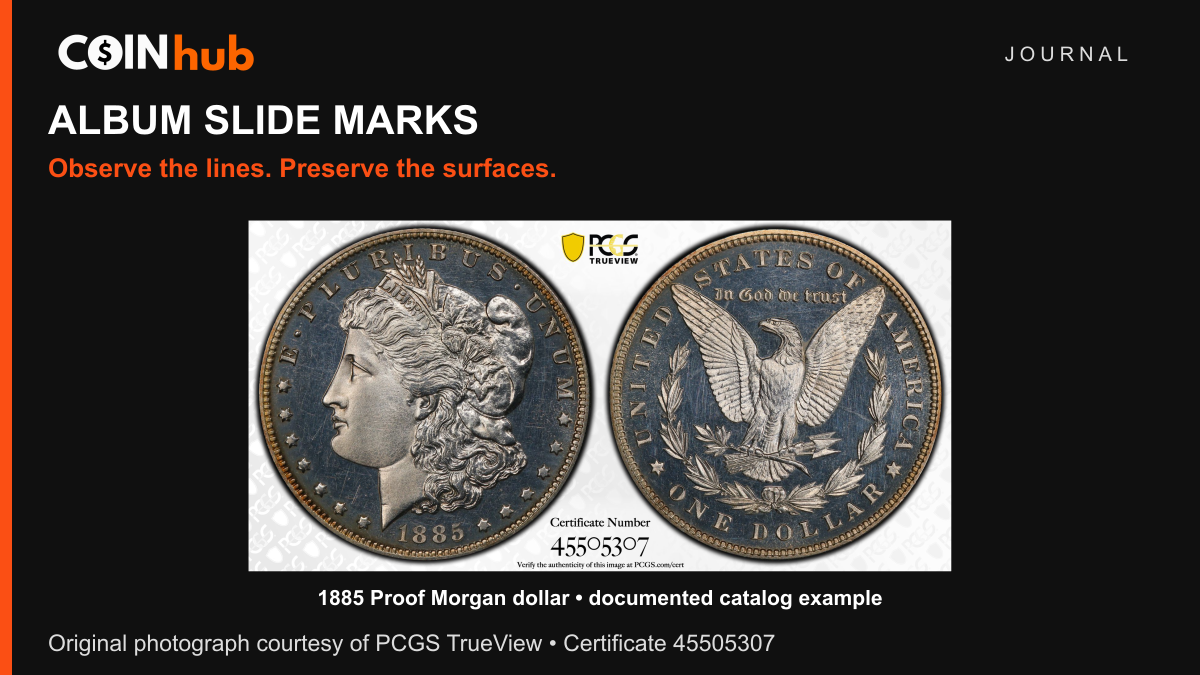
The photograph above is the original PCGS TrueView image for certificate 45505307. Its associated August 2022 Stack's Bowers catalog record, preserved in PCGS Auction Prices, describes an 1885 Morgan dollar graded PR62.
The catalog reports album slide marks on Liberty's cheek and hairlines in the fields. It also notes that seeing the marks requires a particular angle to the light. That observation is a useful reminder that a full-coin photograph and an in-hand inspection can reveal different amounts of surface information.
The grade belongs to that specific coin. It is not a rule that a Proof with slide marks must grade PR62, and the catalog's proposed explanation for the grade is not a grading-service formula. No arrows or fabricated scratches have been added to the photograph.
Slide marks, album friction and cleaning are different descriptions
| Term | What the description emphasizes | What to keep separate |
|---|---|---|
| Album slide marks | Lines associated with a moving album slide. | A confident cause may require more evidence than parallel appearance. |
| Album friction | PCGS notes that this can be slight rubbing on high points. | Not every rubbed area has the same pattern or extent. |
| Hairlines | Fine surface lines, whose visibility depends on the surface and lighting. | The descriptive word alone does not supply the object's entire handling history. |
| Cleaning claim | A proposed treatment or alteration of the surface. | A particular cleaning method cannot be reconstructed merely from a seller's shorthand. |
For the separate comparison with lines originating on a die, see our die polish and cleaning-hairline guide. Here the focus is the storage contact itself and how to avoid repeating it.
Do slide marks automatically mean a Details grade?
Do not apply an automatic label. PCGS's discussion of contact marks shows why location and severity matter when surfaces are evaluated. A mark in an exposed portrait area may have a different visual impact from one hidden among detailed devices.
A named surface concern still needs assessment in the context of the whole coin. Read the actual service result and any qualifier. Our Details-grade guide explains those labels, while the impaired-Proof guide separates Proof manufacture from later condition.
Reduce contact before you move a slide
- Check the fit. Use a holder designed for the coin. If the coin protrudes into the slide's path or the page is distorted, stop before moving the slide across it.
- Avoid forcing a resistant slide. Inspect the arrangement and follow the album manufacturer's instructions. Pressure is not a substitute for a clear path.
- Keep surfaces untouched. Do not press directly on the design to push the coin out of the way. Use an edge-first handling routine when handling is necessary.
- Choose access thoughtfully. If a coin needs frequent examination, consider whether a different appropriate holder would reduce repeated movement near its surfaces. Our holder checklist helps compare practical needs.
These precautions address mechanical contact. They do not establish that any particular album material is chemically safe, nor that an old album has caused all the marks on a coin now stored in it. Keep material suitability and physical handling as separate checks.
Should I wipe a coin to make the lines easier to see?
No. Wiping adds another contact event and can change the very evidence you are trying to inspect. Preserve the coin, improve the lighting and ask a qualified professional when the surface concern matters to a decision.
Sources and photograph: PCGS references and the identified auction description checked September 27, 2026. Full PCGS TrueView image used with permission, including its original logo and certification number. Catalog observations are attributed to the documented specimen.