
Small change used to offer some surprising choices
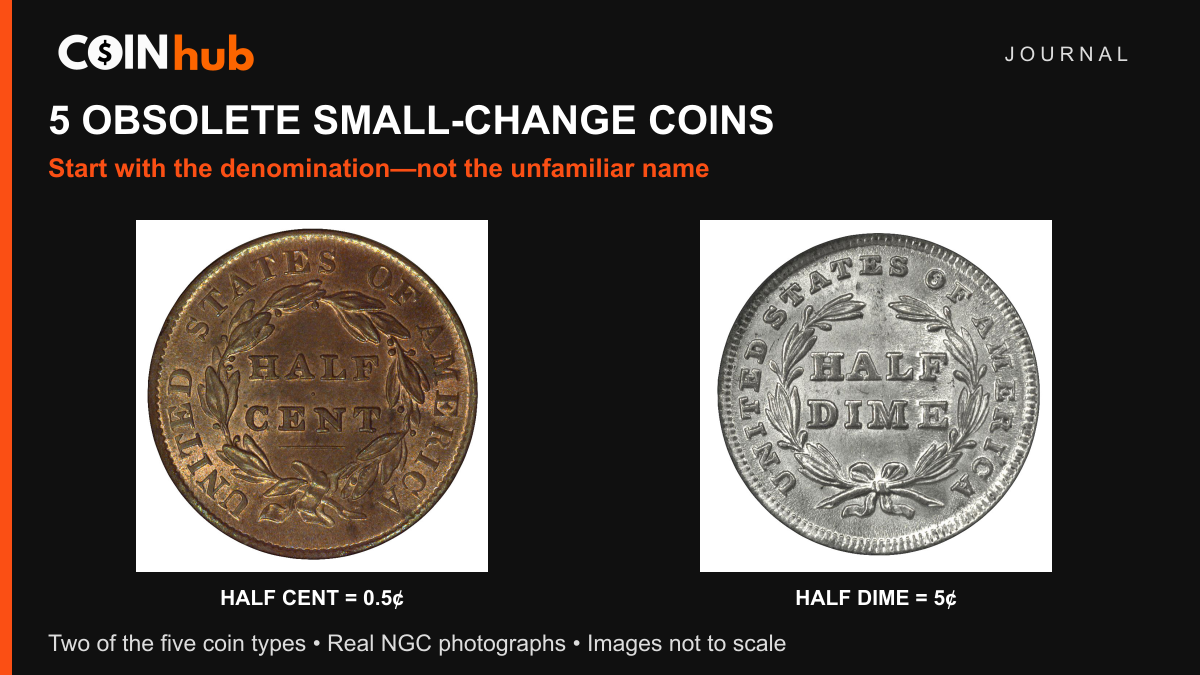
A coin marked HALF CENT and one marked HALF DIME do not represent the same amount. The first carried a face value of one-half cent; the second, five cents. That tenfold difference is a useful starting point for exploring obsolete U.S. small-change coins.
These five entries introduce denominations and coin formats that can look unfamiliar today. They are not a complete list of discontinued American coins, and their historical face values are not estimates of collector value. Identification comes first; date, authenticity and condition come later.
Five coins, with their face values kept straight
| Coin | Original face value | Dates to recognize | First identification clue |
|---|---|---|---|
| Half cent | 0.5 cent | 1793–1857 | HALF CENT on the reverse |
| Two-cent piece | 2 cents | 1864–1873 | 2 CENTS inside a wreath |
| Three-cent pieces | 3 cents | Silver: 1851–1873; nickel: 1865–1889 | Roman numeral III; identify the correct metal/design family |
| Half dime | 5 cents | 1792 half disme; regular series 1794–1873 | A silver five-cent coin; later types spell out HALF DIME |
| Twenty-cent piece | 20 cents | 1875–1878 | TWENTY CENTS and a plain edge |
These are overall date spans, not promises that every date and mint combination exists. Some final issues were made for collectors rather than ordinary circulation.
1. Half cent: a fraction of a penny
The copper half cent supplied a unit smaller than one cent. PCGS traces the denomination from 1793 through 1857. Its unfamiliar value is often the first surprise; its name is also easy to confuse with the much more valuable-at-face half dime.
Read the denomination on the reverse before working from the portrait alone. The photograph above shows the HALF CENT wording on a Classic Head example. For that particular design, use our Classic Head half-cent guide after making the initial identification. Do not assume every half cent has the same obverse design.
2. Two-cent piece: a small coin with a lasting motto
The two-cent piece joined American coinage in 1864. The U.S. Mint’s historical timeline records its authorization that April and identifies it as the first U.S. coin to carry “In God We Trust.” The series extends through 1873.
For a beginner, the reverse’s large 2 and CENTS make a better starting point than trying to judge a motto variety from a distant photograph. Once the denomination and date are clear, our two-cent piece guide provides the series-specific next step.
3. Three-cent pieces: one amount, two different families
The Mint’s historical denomination list separates silver three-cent pieces, dated 1851–1873, from nickel three-cent pieces, dated 1865–1889. Their date ranges overlap. A date alone therefore cannot tell you which family you have.
Look at the whole design. The tiny silver type has a star-and-shield obverse; the nickel type has a Liberty portrait. Both use III to express three on the reverse. “Nickel” in this name describes the coin family, not a five-cent face value. Compare the designs in our three-cent silver versus nickel guide before choosing a catalog entry.
4. Half dime: five cents in silver
A half dime is half of a ten-cent dime: five cents. The PCGS half-dime overview includes the 1792 half disme and the regular series beginning in 1794 and ending in 1873. The familiar copper-nickel five-cent coin arrived while silver half dimes were still being made.
This is the important exception to a loose definition of “obsolete denomination.” Five cents did not disappear; the silver half dime did. The reverse pictured above belongs to the Liberty Seated family. Our Liberty Seated half-dime guide explains that design without treating the small coin as a miniature ten-cent piece.
5. Twenty-cent piece: close to a quarter, but not a quarter
The twenty-cent piece had a brief run from 1875 through 1878. PCGS explains that 1877 and 1878 issues were Proof-only. Its resemblance to the quarter helped make it confusing in use.
Read TWENTY CENTS on the reverse and inspect the plain edge. A Liberty Seated quarter has a different denomination and a reeded edge. Neither appearance nor an edge check alone authenticates an unfamiliar specimen, but the combination helps prevent an obvious catalog mix-up. The twenty-cent piece guide covers the series in more detail.
Make a useful record before looking up a price
If one of these coins turns up in a family collection, record the exact denomination, visible date and any mintmark. Photograph both sides and the edge, and keep the coin with its existing label or provenance. Copy what the coin actually says rather than silently correcting an unfamiliar name.
Then match it to the proper series reference. A search for “old silver coin” can return an impressive price that belongs to an entirely different denomination or condition. A better inventory entry might read “Liberty Seated half dime, five cents, date visible, authenticity not yet assessed.” It says what is known without promising a grade or value.
Does obsolete mean rare or valuable?
No. A discontinued format is an interesting subject, not a price guarantee. Individual dates, varieties, preservation and authenticity determine the next questions. Avoid cleaning an unfamiliar coin to make it easier to identify; clear photographs and a knowledgeable examination are more useful starting points.
Sources and photographs: linked U.S. Mint and PCGS references, plus PCGS’s overview of obsolete denominations. Half-cent and half-dime reverse photographs courtesy of NGC, used with permission. CoinHub added labels and layout; original coin photographs are unretouched. Images are not to scale and illustrate two of the five entries.