
Use a Denomination-Specific Timeline
Canadian dime coinage reaches back to 1858; quarters and half dollars began later, and the silver dollar began in 1935. The Mint's specifications list 92.5% silver for 1908-1919 dimes, quarters and halves, followed by 80% silver standards beginning in 1920.
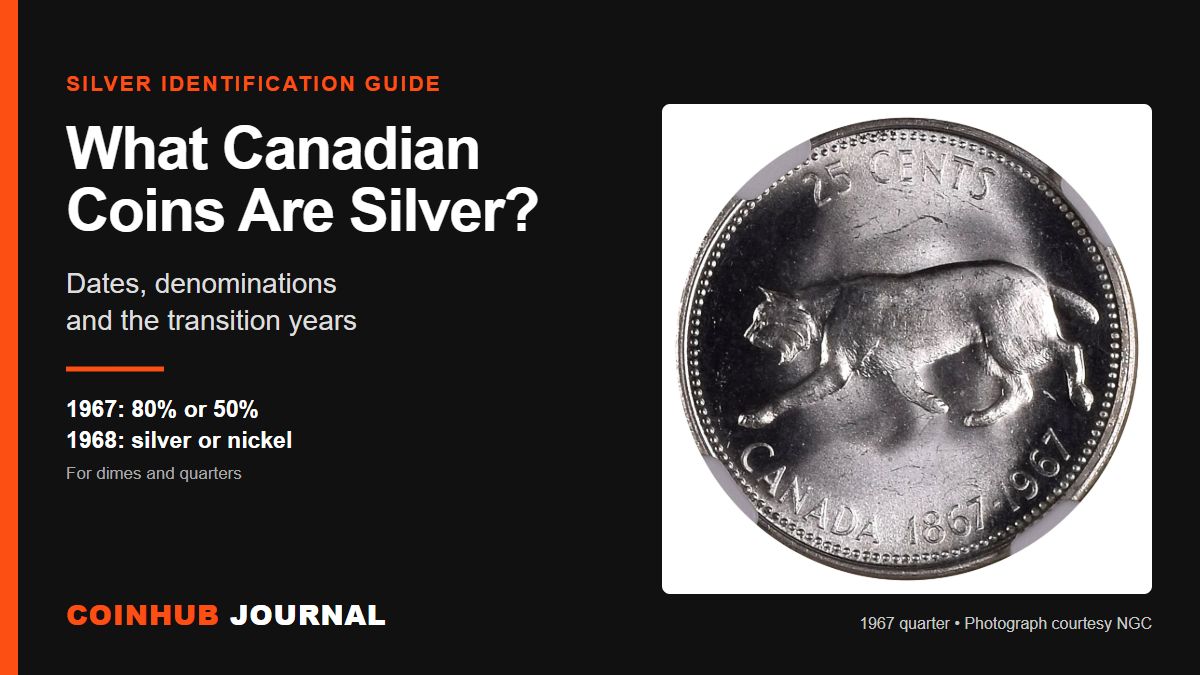
Dimes and quarters dated 1967 can be 80% or 50% silver. In 1968, both silver and nickel versions exist. Half dollars and dollars follow a different boundary: their standard 1935-1967 dollar and 1920-1967 half-dollar issues are 80% silver, with nickel replacing silver in 1968.
Resolve the Transition Before Calculating
Do not settle a 1967 dime or quarter's fineness by color. Record weight and magnet response as screening observations, and obtain qualified composition review when needed. A magnet cannot distinguish the two silver finenesses or authenticate an important coin.
The fish, wildcat, wolf and goose on 1967 denominations are intentional Centennial designs. Their novelty does not establish a mint error. Later collector silver products are separate from the circulation timeline, and a modern commemorative certificate should not be applied to an older loose coin.
Compare Metal and Collector Evidence Separately
For common worn pieces, use the confirmed alloy and correct denomination's weight in a dated metal-content calculation. Theoretical content is not a guaranteed purchase offer. Do not average mixed transition coins at the highest silver percentage simply because identification is unfinished.
For collector evidence, compare exact issue, variety and preservation; distinguish circulation, specimen and proof finishes. Keep a CAD sale labeled CAD until a dated exchange rate supports a USD comparison. The linked Canadian sorting guide provides deeper denomination coverage.
Confirm what you have
- DenominationRecord the printed denomination, date and both designs. Similar size or color cannot substitute for identifying the coin's actual denomination.
- Transition CoinsKeep 1967-1968 dimes and quarters separately labeled until composition is resolved. Record test observations without certifying an alloy from appearance.
- CurrencySave the sale's original currency, date and fees. Canadian face value and a U.S.-dollar market comparison are different quantities.
Before you put a price on it
- Calling every 1968 Canadian coin silver.
- Applying the dollar's silver boundary to dimes and quarters.
- Converting CAD to USD by changing the currency label.
Collector questions
Are all 1967 Canadian quarters 80% silver?
No. Both 80% and 50% silver issues exist. The date alone does not choose the correct silver fraction for valuation.
Is a standard 1968 Canadian dollar silver?
No. The standard circulation dollar changed to nickel in 1968. Dimes and quarters from that transition year need different checks.
Are modern silver proofs covered by this timeline?
No. They need their own official product specifications. The circulation-era boundaries cannot identify the metal or finish of every later collector product.
Sources & further research
- Royal Canadian Mint: Dime History and Specifications
- Royal Canadian Mint: Quarter Silver and Nickel Transitions
- Royal Canadian Mint: Half-Dollar Specifications
- Royal Canadian Mint: Dollar Specifications
- Royal Canadian Mint: Dime Silver Transition History
- PCGS: Canadian Dime Issue Classification Including 1968 Silver
- Royal Canadian Mint: Canada's First National Coinage History

Reviewed 2026-10-12. Coin identification, grade and value are separate questions. No guide or checkmark is professional authentication or an appraisal.
