
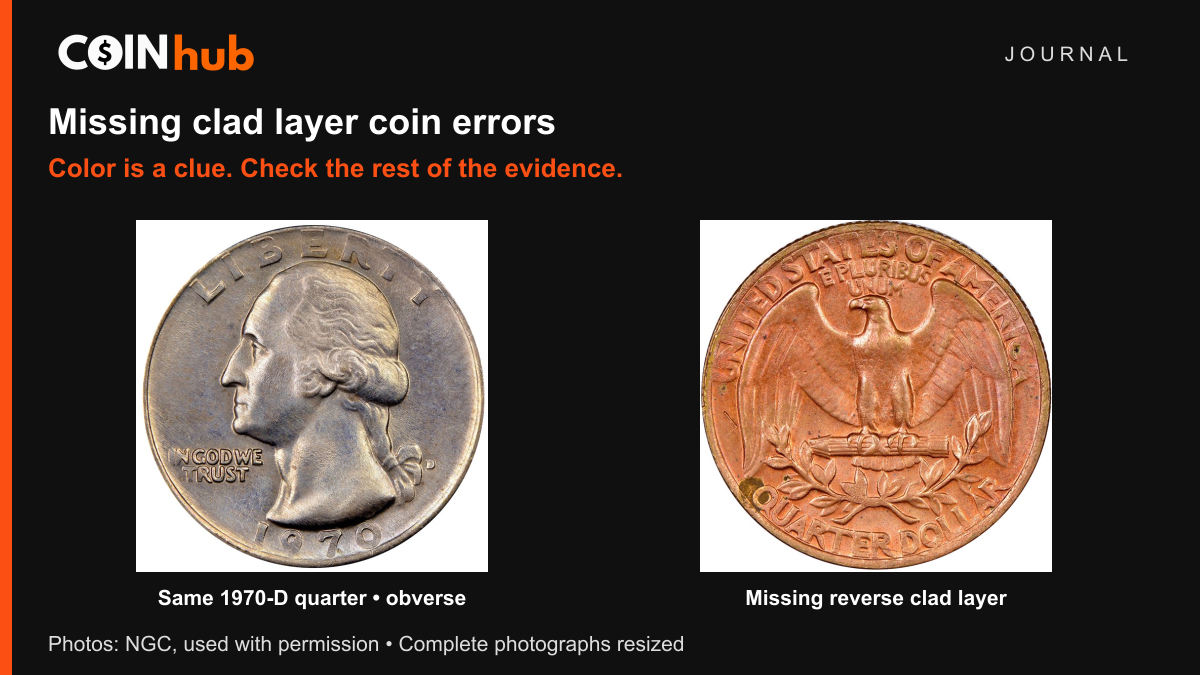
A missing clad layer coin error means a coin has lost part or all of an outer metal layer made at the Mint. On a copper-nickel clad coin, that can expose a copper-colored face. Color is a clue, not proof: coatings, changes to the surface and damage can also make a coin look coppery.
Start with both faces, the edge and the coin's weight. Ask whether those clues fit a lost original layer. Do not name the error from one reddish photograph.
What is missing from the coin?
A normal copper-nickel clad quarter has a copper core between copper-nickel outer layers. Those faces are not pure nickel. Our explanation of clad coinage covers the metal structure and why clad does not always mean silver-free.
PCGS's specialist overview describes full, partial and dual missing-layer errors. A full loss affects one whole face; a partial loss leaves some of that layer in place. Dual means both outer layers are absent. These names tell you how much is gone. They do not set a grade or price.
NGC explains that a layer may be missing before the strike or may separate afterward because its bond was loose. You need more clues to work out the timing. A bare area does not show when or why the metal left.
Read the genuine quarter example
The two photographs above show the same 1970-D Washington quarter. NGC identifies it as Mint Error MS64, Missing Clad Layer on Reverse. Its front has the familiar gray appearance, while the eagle side exposes copper-colored metal.
That grade and error label belong to this known coin. NGC's article does not supply a measured weight for it, so no weight is assigned to the pictured quarter here. A similar color is a reason to look closer. It does not give your coin the same error label.
Use weight as one part of the record
The U.S. Mint lists 5.67 grams as the nominal weight of a normal clad quarter. Check the coin's date, type and metal before you choose a reference. A silver collector version needs a different comparison.
A missing layer reduces the metal present, but a low reading can have other causes. Check the scale, weigh the coin without packaging and repeat the measurement. Leave certified coins sealed in their holders. Wear, removed metal and an incorrect reference can change the result. Keep the number separate from the explanation.
A worksheet example: A quarter measured at 4.90 grams is 0.77 grams below a 5.67-gram reference. That shows a weight gap. It does not prove that the coin has a Mint error. These are example numbers. The pictured NGC coin was not weighed for this guide.
The CoinHub Coin Weight & Size Checker can compare a supported coin type with your measured weight and diameter and save a session worksheet as CSV. It does not determine the metal or explain a missing layer. Our coin-weighing guide covers careful measurement.
Look beyond the color
NGC's study of Presidential dollars warns that copper-colored plating and improper annealing can resemble missing-layer errors. Annealing is a heat-treatment step in production. Those examples are dollar coins. They show why color alone is not enough.
| Observation | Useful record | Limit |
|---|---|---|
| Color | Both faces in neutral light | Does not identify the metal or cause |
| Weight | Repeated readings and exact reference | Does not show when metal was lost |
| Edge and surface | Clear views of the whole edge and any boundary | A photo may hide marks or a coating |
| Holder label | Full attribution and matching certification | Applies to that specimen, not every look-alike |
Keep related terms separate
A missing bonded face layer is a different question from a design struck on the wrong blank. A split within a solid-alloy planchet is another mechanism. Smaller cracks and peels may instead raise a lamination question. Keep notes on what you can see. Thin coins and coppery coins do not all have the same cause.
Do not scrape, file, peel or chemically test a suspected layer. Take photos while the coin is intact. Ask an error expert to examine it when the answer matters. Compare sold examples only after matching the error, issue, condition and surface problems; an asking price is not a completed sale.
For further reading, CoinHub founder Blake Alma's The CoinHub: An Ultimate Guide to Coin Errors is an optional CoinHub resource. It does not replace examination of a possible find.
NGC specimen photographs used with permission, with complete faces resized. Primary references checked October 13, 2026. This guide does not name an error or price for an unseen coin.